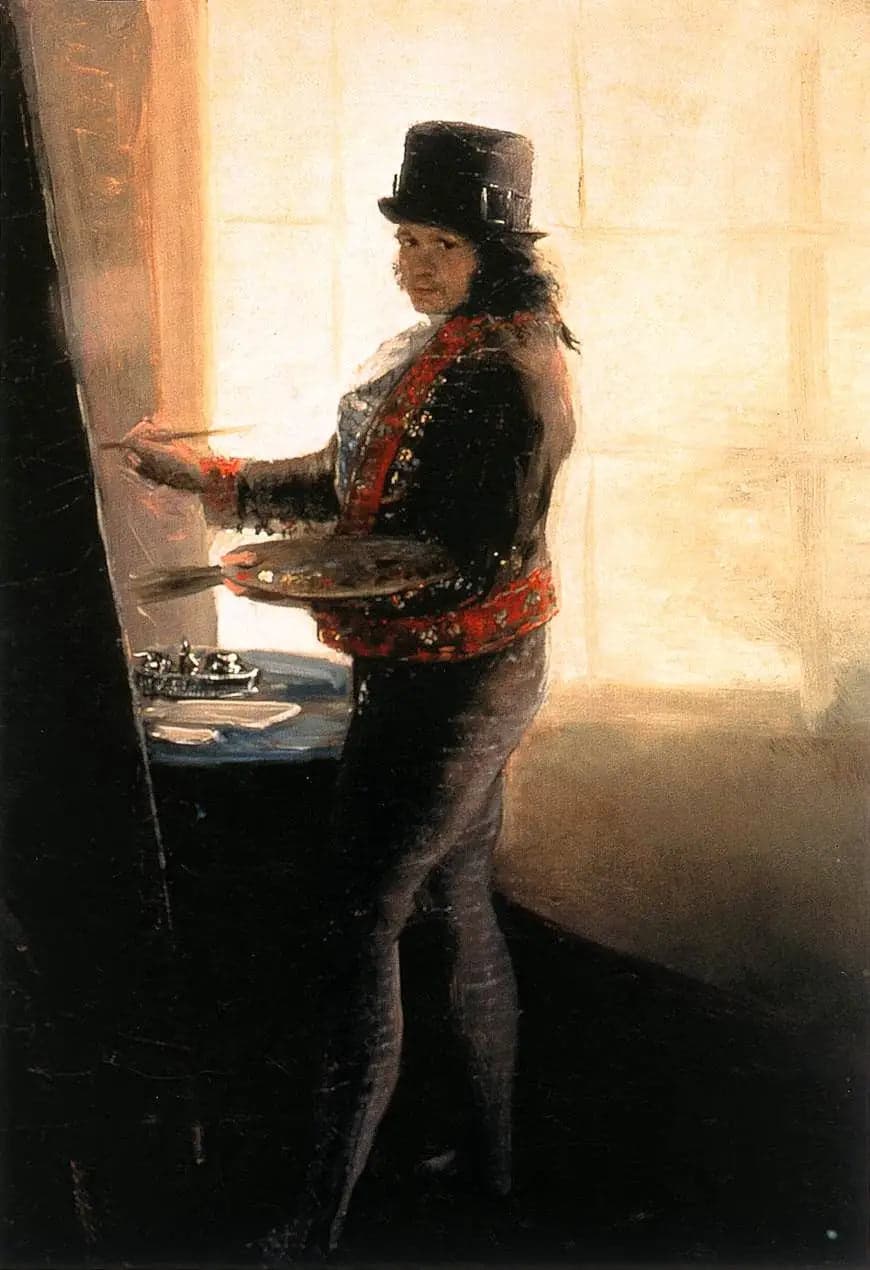
Self-Portrait in the Studio
- Original dimensions
- 28 x 42 cm
- Movement
- romanticism
- Museum
- Royal Academy of Fine Arts of Saint Ferdinand
- Year
- 1790
Scene depicted
This painting is introspective, with each brushstroke revealing an intimate part of Goya, immersing us in his studio, a sanctuary of creativity where the artist stages himself. The painting reflects his creative process, his reflections on art and society, and evokes a sense of authenticity that invites observers to share his personal universe, through the prism of his unique vision.
Historical context
Created in 1790, in the heart of vibrant Madrid, Self-Portrait in the Studio bears witness to a time when romanticism was emerging as a new breath in the artistic world. The work, preserved at the Royal Academy of Fine Arts of Saint Ferdinand, perfectly integrates into the rich cultural landscape of late 18th century Spain. This painting of modest dimensions, 28 x 42 cm, unfolds an emotional depth that captivates the gaze and the mind.
Place in the artist's career
Occupying a central place in Goya's career, Self-Portrait in the Studio marks both a turn towards introspection and a completed stylistic achievement. This painting in dialogue with The Executions of May 3, 1808 and The Naked Maja , shows the maturation of his artistic approach, oscillating between realism and personal expression, thus revealing an increased emotional depth.
Anecdote
“In every brushstroke, there is a part of me, a reflection of my quest, of my passion.” Thus might Goya have said as he captured the moment of inspiration for his masterpiece . Imagine a cool morning, dawn gently illuminating his studio, where the sensations of light and colors danced around him, urging him to immortalize his essence on the canvas.