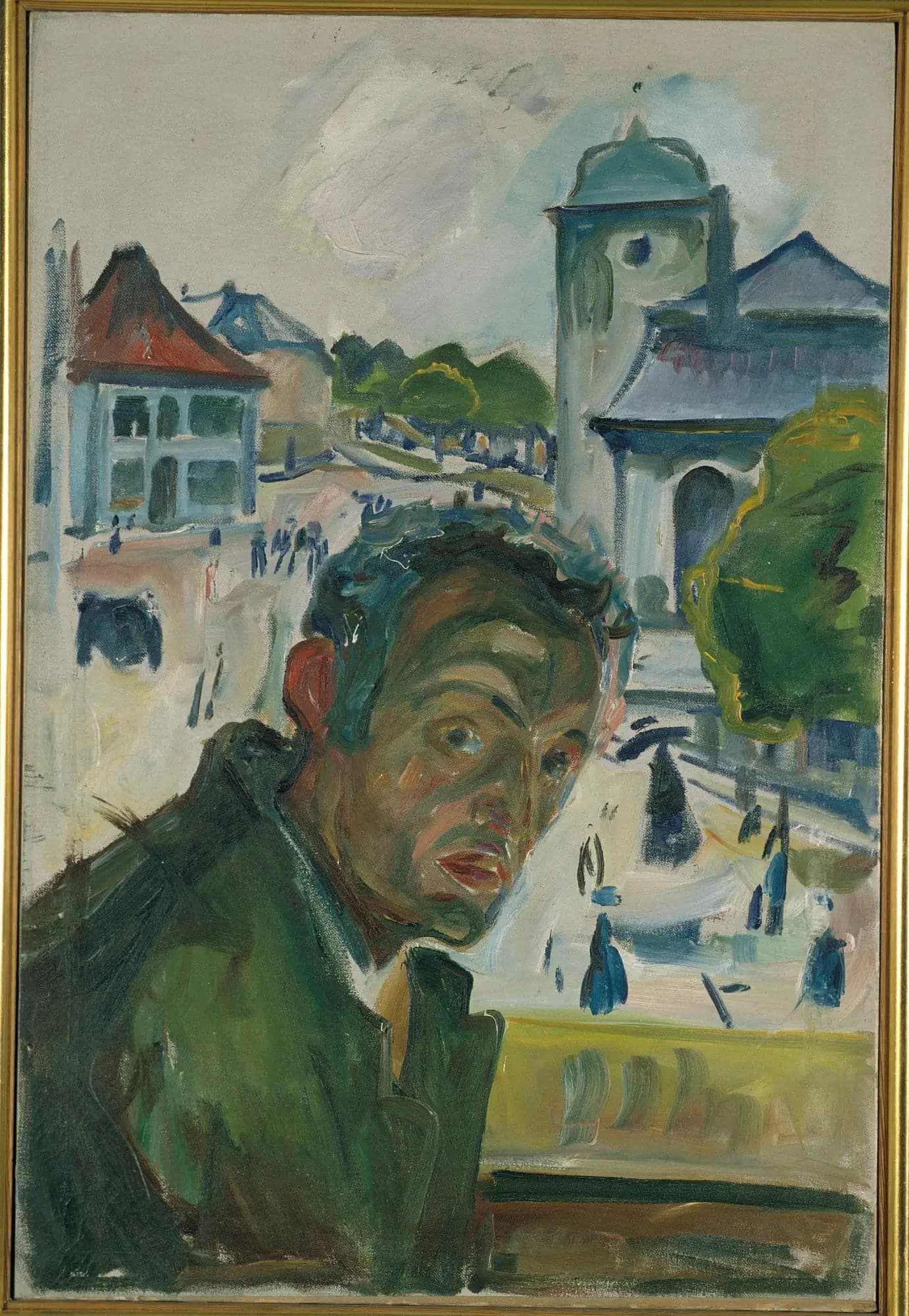
Self-Portrait in Bergen
- Original dimensions
- 60 x 89.5 cm
- Museum
- Munch Museum
- Year
- 1916
Scene depicted
In this work, Munch depicts himself with an introspective gaze, immersed in his thoughts where light mingles with the shadows of his mind. The subtly crafted details of the canvas capture a duality between anguish and serenity, inviting the viewer to share the intimacy of an introspective moment while evoking the torments of existence.
Historical context
Created in 1916, this painting evokes the emotional turmoil of an era marked by profound changes. Located in Bergen, the ancestral city of Norway, this work reflects an artistic movement that defies conventions: Expressionism . Through his unique vision, Munch captures the essence of a tormented humanity. The canvas is currently exhibited at the Munch Museum, an institution dedicated to celebrating the master's art, where it fascinates visitors with its striking dimensions.
Place in the artist's career
The painting “Self-Portrait in Bergen” is at the heart of Munch's career, encapsulating a period of stylistic maturity. This pivotal moment can be paralleled with “The Scream” and “The Madonna,” two other iconic paintings that foreshadow the emotional intensity and technical mastery already visible in this work .
Anecdote
“The soul of an artist is a canvas itself, marked by every emotion and every trial.” This reflection from Edvard Munch resonates through his masterpiece , created one spring morning as he contemplated the fjord of Bergen. This moment of gratitude in the face of natural beauty infused an evocative strength into the painting , transforming a simple image into a profound emotional narrative.
Major exhibitions
Munch og Ekely: 1916-1944