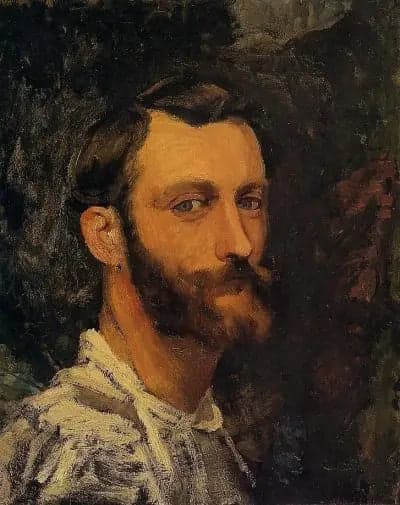
Self-Portrait
- Original dimensions
- 38 x 46 cm
- Museum
- Not specified
- Year
- 1870
Scene depicted
In this masterpiece , Bazille immerses himself in artistic introspection, revealing to us his unique way of seeing the world. The artist celebrates not only his appearance but also evokes the complexity of self-employment in the creative process. By using his own figure as a subject, the painting reveals a personal connection between the painter and his art, thus creating an intense visual dialogue.
Historical context
Created in 1870, this painting is emblematic of the Impressionist era, in Marseille, during a fertile artistic climate. Free from academic conventions, Bazille explores his own identity, translating a modern vision in his canvas . Currently, the painting is in a private collection that preserves its legacy, reflecting a period of artistic upheaval, demanding a new approach to light and color.
Place in the artist's career
This painting represents a turning point in Bazille's career. As he oscillates between the influences of his time, this canvas illustrates his innovative approach. By paralleling it with works such as "The Family Reunion" and "The Artist's Studio," one can observe an evolution towards a more fluid and emotional technique, marked by the emergence of his distinct style.
Anecdote
“To paint is to explore oneself.” That morning, in the gentle light of spring, Bazille stands before his mirror, in his light-filled studio. It is a painting that captures not only his image but the essence of an artist in full quest for authenticity. With the vibrant energy of the moment, this work becomes the mirror of his soul, a fleeting instant frozen on the canvas .