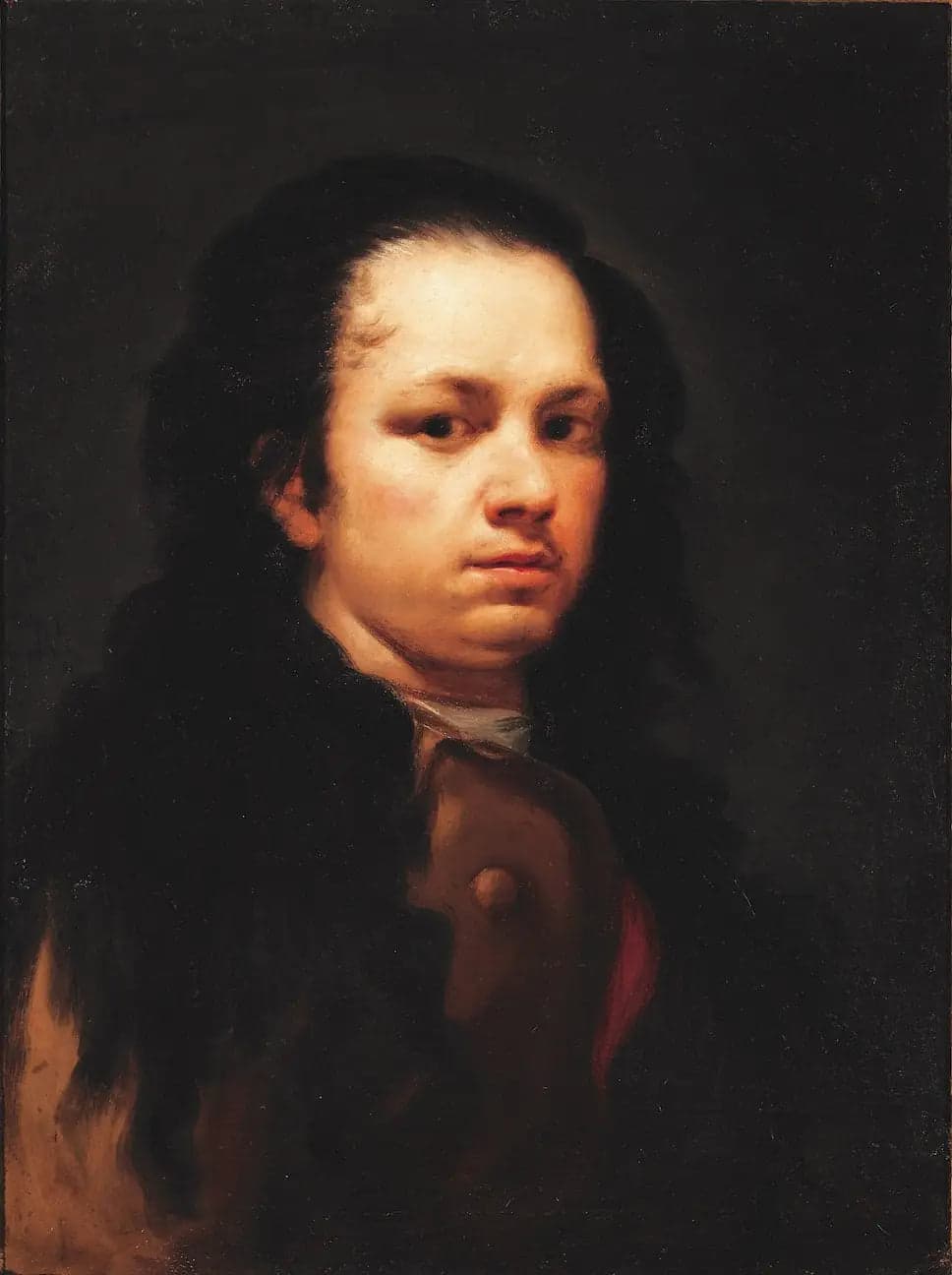
Self-Portrait
- Original dimensions
- 60 x 86 cm
- Museum
- Museum of Fine Arts of Agen
- Year
- 1783
Scene depicted
In his canvas , Goya portrays himself with a rare emotional intensity. His face betrays a deep introspection, an introspection imbued with pride and melancholy, marked by shadows that dance with the light. The compactness of the painting makes palpable the solitude of the artist in front of his own reflection, creating a timeless link between his inner world and the viewer's gaze.
Historical context
Created in 1783, this painting masterfully reflects a pivotal period in Spain, then dominated by bourgeois rituals and norms. Francisco de Goya , a leading figure of Romanticism, stands out with a unique style that blends sensuality and introspection. The canvas is currently displayed at the Museum of Fine Arts of Agen, where it overlooks visitors with its penetrating and mysterious gaze.
Place in the artist's career
This painting is emblematic of a transitional phase in Goya's career. It marks a shift towards more personal achievements, as evidenced by other canvases such as “The Naked Maja” and “The Executions of May 3rd,” both revealing a strong emotional commitment and a notable stylistic evolution.
Anecdote
“The true strength of an artist lies in his gaze,” Goya is said to have remarked one morning while contemplating his reflection in a broken mirror, a poignant allusion to the genesis of this canvas . This moment of illumination led him to capture not only his appearance but also the tormented soul that inhabited him, so clearly apparent in his masterpiece .