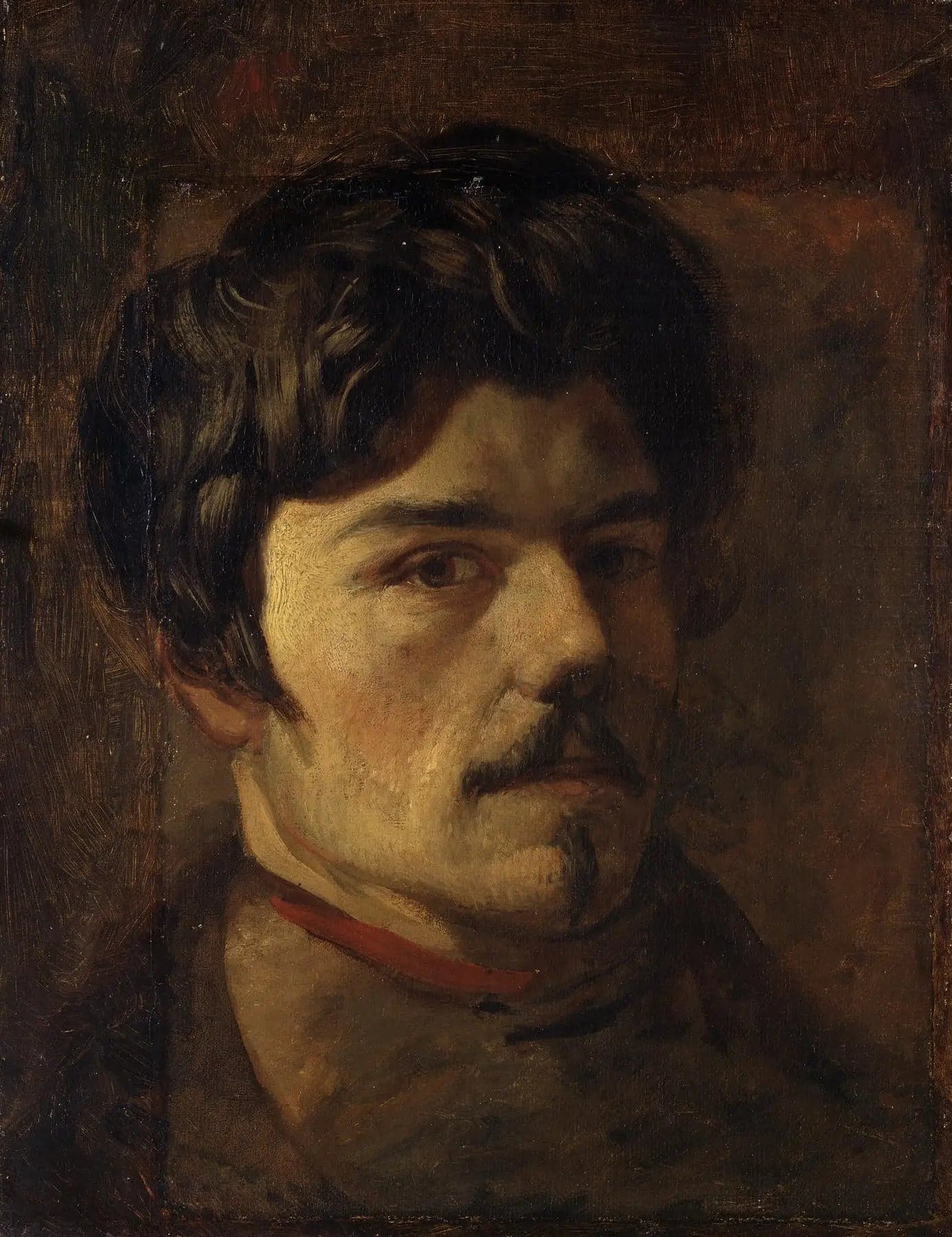
Self-Portrait
- Original dimensions
- 28 x 36 cm
- Museum
- Emil G. Bührle Foundation and Collection
- Year
- 1832
Scene depicted
In this painting , Delacroix reveals himself through a burning gaze that merges the viewer with the artist. He presents an introspective vision, where his face becomes a canvas of emotions. The meticulously crafted composition testifies to his technical mastery, while evoking the anxiety and artistic passion that characterize him. This painting thus becomes the receptacle of an inner journey, oscillating between light and shadow, a reflection of a tormented soul.
Historical context
Created in 1832, this iconic painting was born in the heart of Paris, a city then pulsating with artistic innovations and intellectual movements. Eugène Delacroix , a leading figure of romanticism , captures through this canvas the whirlwind of human emotions, while fitting into a tradition that celebrates individuality and passion. This masterpiece is currently preserved at the Emil G. Bührle Foundation and Collection , a place that carefully preserves artistic heritage. Its dimensions are small yet powerful, expressing a rare intimacy and depth.
Place in the artist's career
This canvas represents a decisive turning point in Delacroix's career. It illustrates not only his boldness but also his artistic maturity. Compared to his famous painting “ Liberty Leading the People ,” created a few years later, and to his work “ The Death of Sardanapalus ,” this painting bears witness to a technical evolution where light becomes the true protagonist, transforming each canvas into a visual epic.
Anecdote
“In every face, there is a story, and in every gaze, a breath of life.” At that time, Delacroix finds his inspiration in the melancholy of a spring morning, as he strolls through the cobbled streets of Paris. It is by crossing paths with faces imbued with raw emotion that he decides to represent himself, thus revealing the evocative power of the self-portrait .