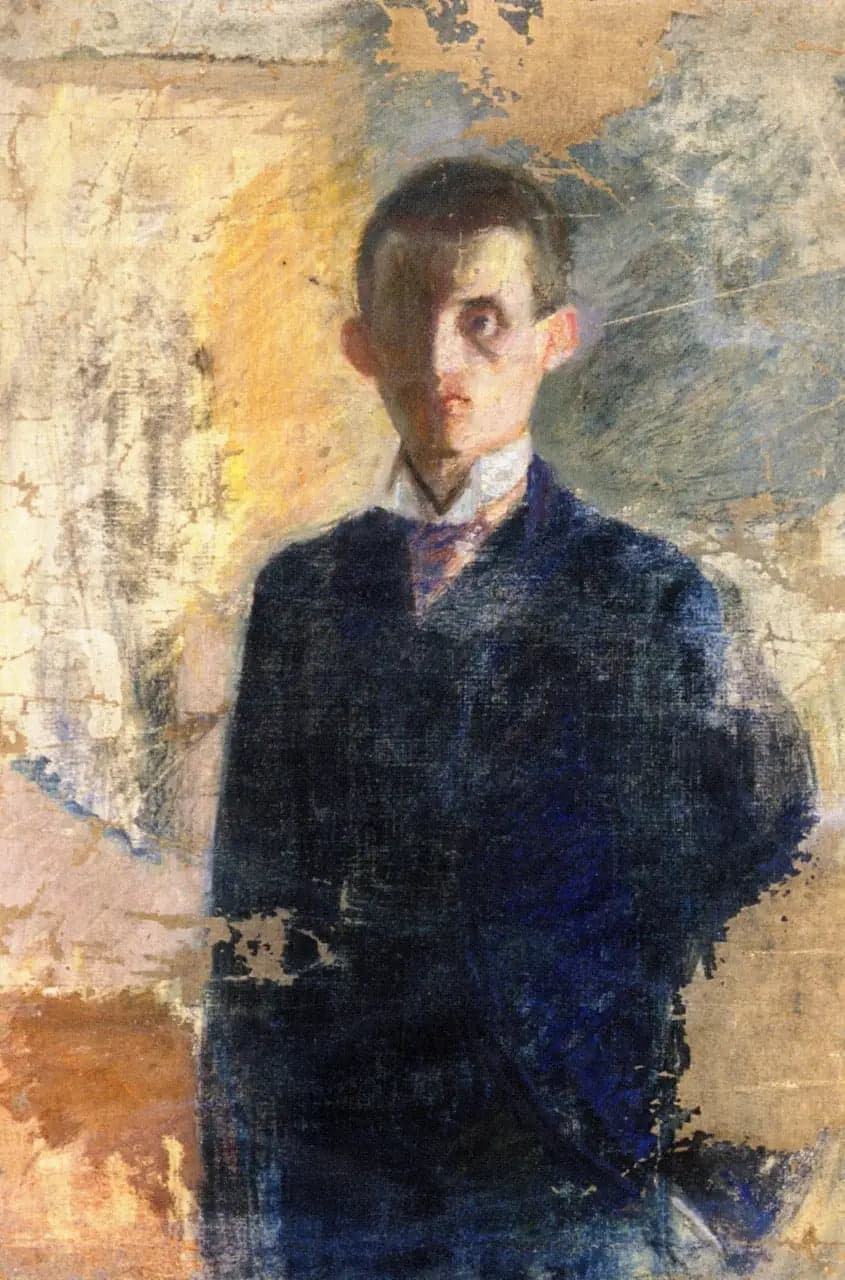
Self-Portrait
- Original dimensions
- 35.5 x 43.5 cm
- Museum
- Oslo City Museum
- Year
- 1882
Scene depicted
In this canvas , Edvard Munch exposes himself with disconcerting intensity. His face, imbued with melancholy, stands out against a vibrant background, where each brushstroke seems to tell a story of anxiety and existential crisis. The self-portrait reflects not only the psyche of the artist but also an era marked by deep questioning about identity and the human condition. The sincerity of this painting is unsettling, inviting the viewer to dive into their own reflections.
Historical context
Created in 1882 in the vibrant city of Oslo, this painting is part of the expressionist movement, a current that seeks to express emotion before reality. This canvas is currently exhibited at the Oslo City Museum and measures 35.5 by 43.5 cm, reflecting a time when art breaks free from conventions. The canvas bears witness to the inner turmoil and personal reflections of an artist in search of meaning through his own image.
Place in the artist's career
This painting represents a turning point in the career of Edvard Munch . While he explores dark and psychological themes, this masterpiece is situated just before iconic works such as “The Scream” and “The Madonna,” illustrating the emergence of his unique style. Through this period of artistic maturity, Munch carves out a visual identity that will distinguish him, blending raw emotion and innovative aesthetics.
Anecdote
“Anxiety and beauty are just a step apart,” said Munch. This quote makes perfect sense when imagining the moment of creation of this masterpiece . Perhaps it was a spring morning, where the fresh breath of Norwegian air inspired him to create this introspective portrait, like a reflection in a broken mirror. The painting then becomes a silent scream, an ode to human vulnerability.