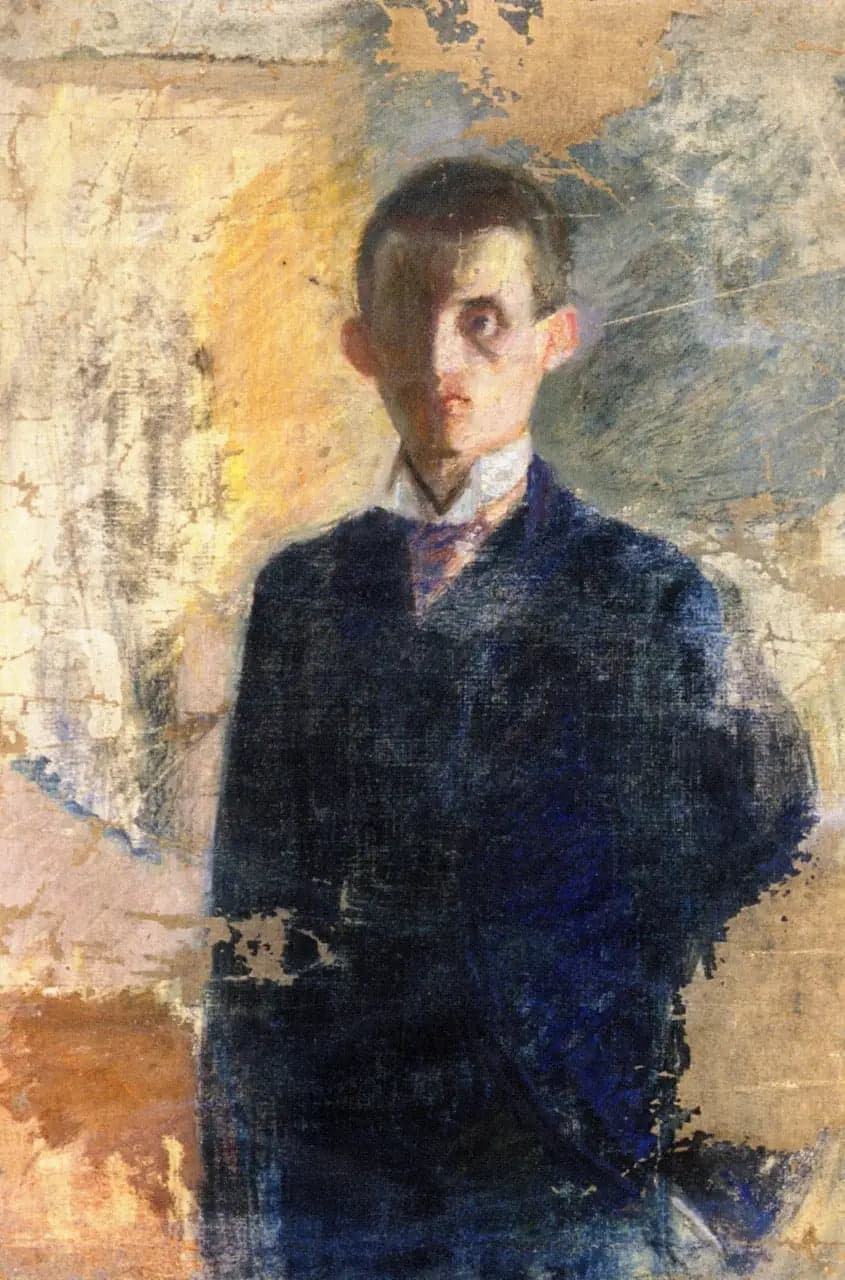
Self-Portrait
- Original dimensions
- 78.5 x 57.5 cm
- Museum
- Munch Museum
- Year
- 1940
Scene depicted
In this canvas , Munch presents himself under an introspective and intense gaze. The work illustrates the struggle with his own demons, his solitude, and his artistic aspirations. Every element, every touch of color tells the story of a man torn between genius and uncertainty. A powerful composition where anguish mingles with emotional beauty, plunging the viewer into a deep and tragic universe.
Historical context
Created in 1940, this painting is set in a rich artistic context, evolving in the heart of Oslo, Norway, a city vibrant with culture and emotions. Coming from the expressionist movement, this canvas depicts the artist's inner turmoil, a time of transformation where each brushstroke tells the shadow and light of the human soul. Today, the canvas resides in the Munch Museum, where it continues to move visitors with its harmonious dimensions of 78.5 x 57.5 cm.
Place in the artist's career
This masterpiece represents a major milestone in Munch's career, symbolizing a period of maturity where he explores themes of suffering and passion. Alongside other iconic canvases like "The Scream" and "The Madonna," Self-Portrait reveals a stylistic and emotional evolution. This artistic journey evokes a freedom of expression, marking his indelible imprint on the expressionist movement.
Anecdote
“Each self-portrait is a journey through my emotions, a quest for light in the darkness,” said Munch, inspired one winter evening, facing his own reflection. This fleeting moment of revelation is imbued with sensitivity; he was then alone in his studio, surrounded by the scent of oils and the sound of brushes on the canvas , this striking memory summarizes the very essence of Self-Portrait .
Major exhibitions
Munch og Ekely: 1916-1944