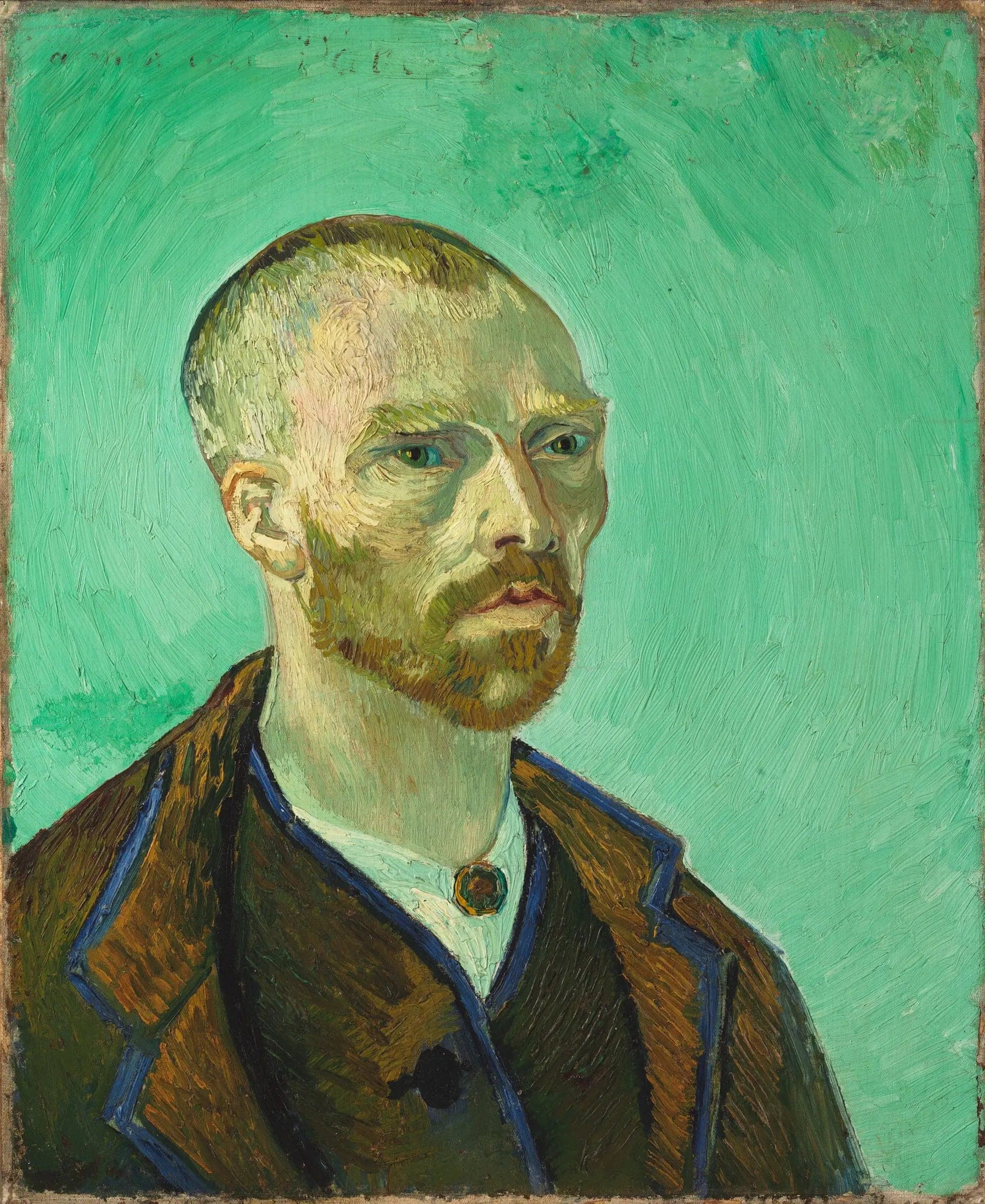
Self-Portrait Dedicated to Paul Gauguin
Scene depicted
This pictorial work represents a determined and introspective Vincent van Gogh , his eyes shining with determination, surrounded by intense colors that evoke his state of mind. It is a striking portrait , both personal and universal, that conveys a vibrant essence, truly rooted in the emotional context of the artist. The gaze, fierce and contemplative, seems to transcend time and space, like a call for deep self-understanding.
Historical context
Created in 1888, during a tumultuous yet creative period in Arles , this painting belongs to the post impressionist movement that redefined the frameworks of art. The canvas is carefully preserved at the Fogg Art Museum , where it testifies to a key time in Van Gogh's journey. Its dimensions are 50.3 x 61.5 cm, a perfect size to capture the essence of the artist and his dedication to color and form.
Place in the artist's career
This canvas marks a crucial milestone in Van Gogh's career, illustrating his style in full maturation. In parallel, works like “ The Sunflowers ” and “ The Starry Night ” reveal a bold journey towards chromatic and emotional experimentation. The Self-Portrait dedicated to Paul Gauguin thus becomes a pivot where raw talent and the quest for artistic identity intersect.
Anecdote
Vincent, in a moment of deep introspection, reportedly stated: “When I paint, I pay myself in terms of emotion.” Imagine him, one spring morning, in his studio bathed in light, passionately sketching this masterpiece in memory of his friend Paul Gauguin. This vibrant memory pulses through every brushstroke of the canvas .