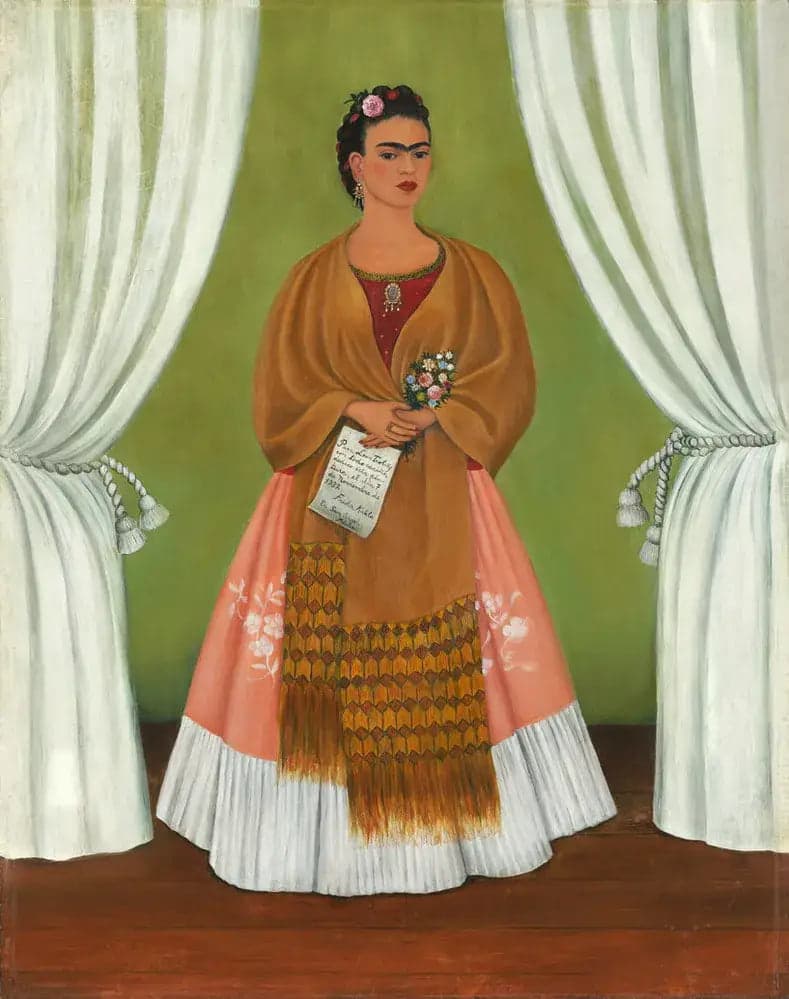
Self-Portrait Dedicated to Leon Trotsky
- Original dimensions
- 24 x 30 cm
- Museum
- National Museum of Women in the Arts
- Year
- 1937
Scene depicted
The painting "Self-Portrait Dedicated to Leon Trotsky" illustrates the internal struggle and burning passion that characterize the life of Frida Kahlo . The composition unfolds like a visual narrative, where her intense gaze communicates a mix of determination and vulnerability. Every detail of the painting carries symbolic weight, reflecting her commitment to her ideals and the man who was a deterrent to the authorities.
Historical context
Created in 1937, at a key moment in Mexican history, the painting titled "Self-Portrait Dedicated to Leon Trotsky" immerses the audience in a context of political and artistic fervor. Frida Kahlo , an emblematic representative of realism and magical realism , immortalizes here the influence of Trotsky, a fervent activist, on her work. This canvas is currently exhibited at the National Museum of Women in the Arts, in Washington D.C., where its visual and emotional impact continues to touch visitors.
Place in the artist's career
This painting occupies a pivotal position in the career of Frida Kahlo , symbolizing a period of profound personal and political upheaval. By juxtaposing it with her earlier works like "The Two Fridas" and her later masterpiece "The Broken Column," one observes an evolution towards a more poignant introspection, marked by a bold exploration of identity and suffering.
Anecdote
“Suffering is a source of inspiration, but love made me alive,” said Frida. In the twilight of a spring in 1937, while contemplating her tumultuous reality in Coyoacán, she began to paint this masterpiece , a vibrant tribute to Trotsky, then in exile. This canvas evokes not only her pain but also a shimmering glimmer of hope, like a star in the night.