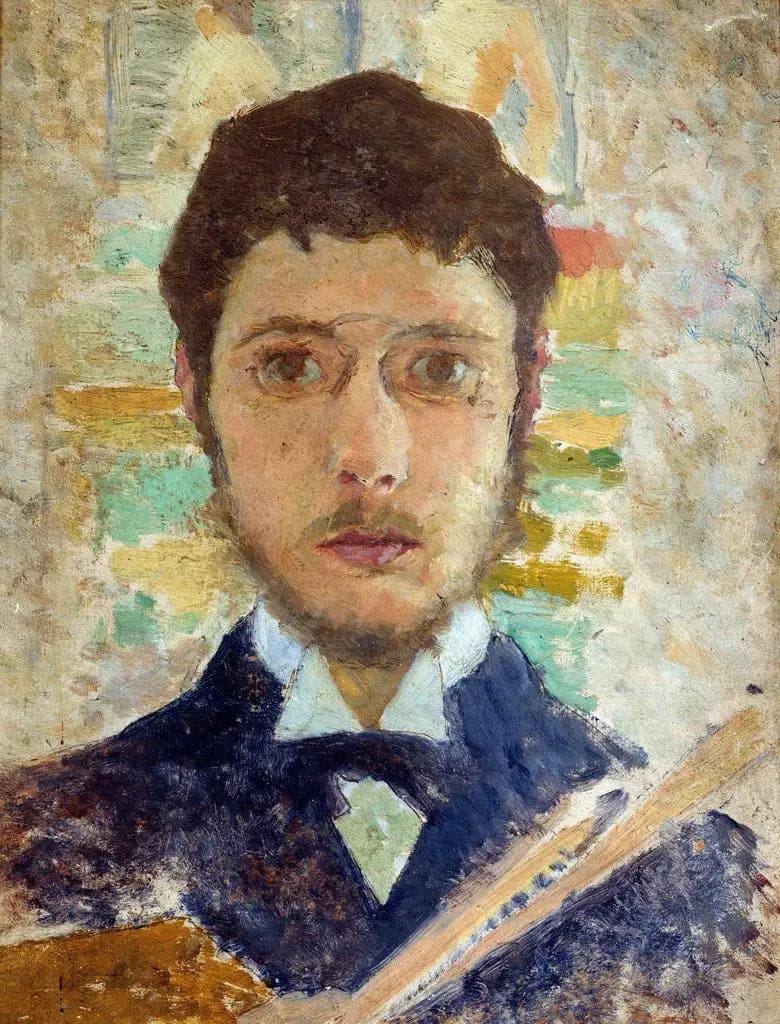
self-portrait by Pierre Bonnard
- Original dimensions
- 15.8 x 21.5 cm
- Museum
- Not specified
- Year
- 1889
Scene depicted
The pictorial work of Bonnard, here in self-portrait, explores the trusting relationship between the artist and the observer. The canvas depicts a moment where the authenticity of his being merges with shadow and light, where each brushstroke highlights a deep emotion. His presence in this masterpiece only enriches this almost palpable connection.
Historical context
Created in 1889 in a France in full artistic effervescence, the painting by Pierre Bonnard , integrated into the post-impressionism movement, is a vibrant reflection of its time. This canvas emblematic immerses us in an atmosphere imbued with intimacy, a frozen moment where the artist questions his own image. Although the current location of this canvas is not specified, its influence endures through time.
Place in the artist's career
The painting self-portrait by Pierre Bonnard marks a transitional phase in his career, blending an introspective approach with a growing mastery of color. In the shadow of this canvas , one can discern echoes of his major works such as “La Terrasse à Vernon” and “Le Grand Nu,” showing his evolution, both technical and emotional.
Anecdote
“The best light comes from within,” said Bonnard. In this masterpiece , he captures a moment of reflection, a sunny morning where each ray of light plays on his features, revealing both vulnerability and strength. The painting becomes a mirror of his soul, a space of dialogue between him and his environment.