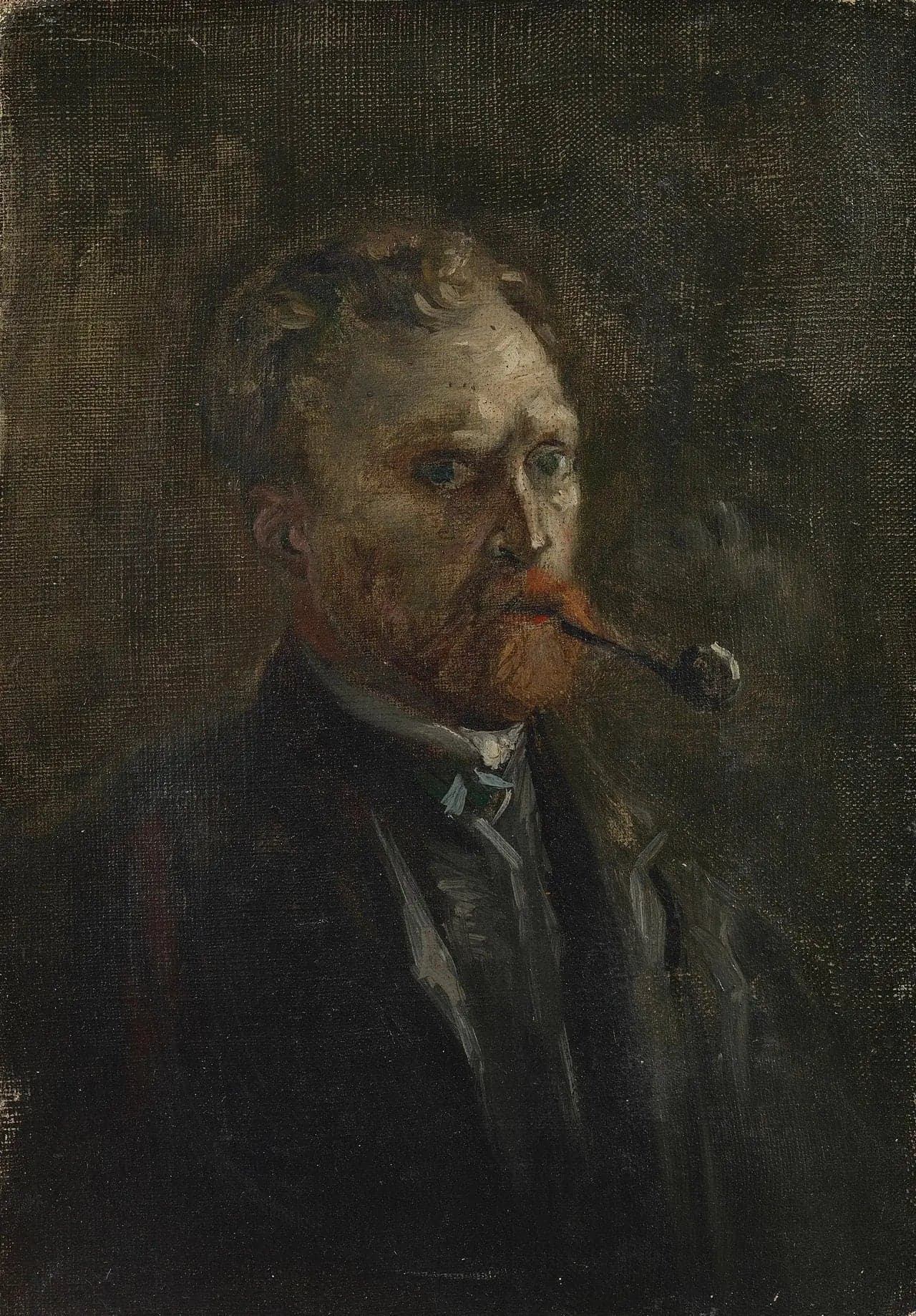
Self-portrait
Scene depicted
In this pictorial work, Van Gogh reveals himself with a rare intensity. His piercing gaze captivates the observer, while the energetic brushstrokes and vibrant colors convey an emotional whirlwind. The canvas thus transforms into a mirror of his psyche, revealing layers of thoughts and emotions that inhabit him.
Historical context
Created in 1887, this painting is unforgettable and belongs to the post-impressionist movement, an artistic current that asserts itself in Paris , the quintessential artistic city. Self-Portrait is currently preserved at the Emil G. Bührle Foundation and Collection , a prestigious setting that attests to its cultural importance. With dimensions of 35.5 x 46.5 cm, this canvas invites an intimate exploration of the soul of its creator.
Place in the artist's career
At the heart of his career, the painting “ Self-Portrait ” reflects the turmoil of Van Gogh's Parisian period. In parallel with works such as “ The Sunflowers ” and “ The Starry Night ”, this painting marks a stylistic evolution signifying a renewal of his technique. It constitutes a turning point, between the search for light and the exploration of shadows.
Anecdote
Van Gogh used to say: “I see myself in my paintings and each project teaches me something about myself.” Inspired by the light of sunny mornings in Paris , it is from his studio that he brought this masterpiece to life, thus revealing his profound solitude and genius. This moment of creation embodies a quest for truth and beauty, making this painting all the more emotive.