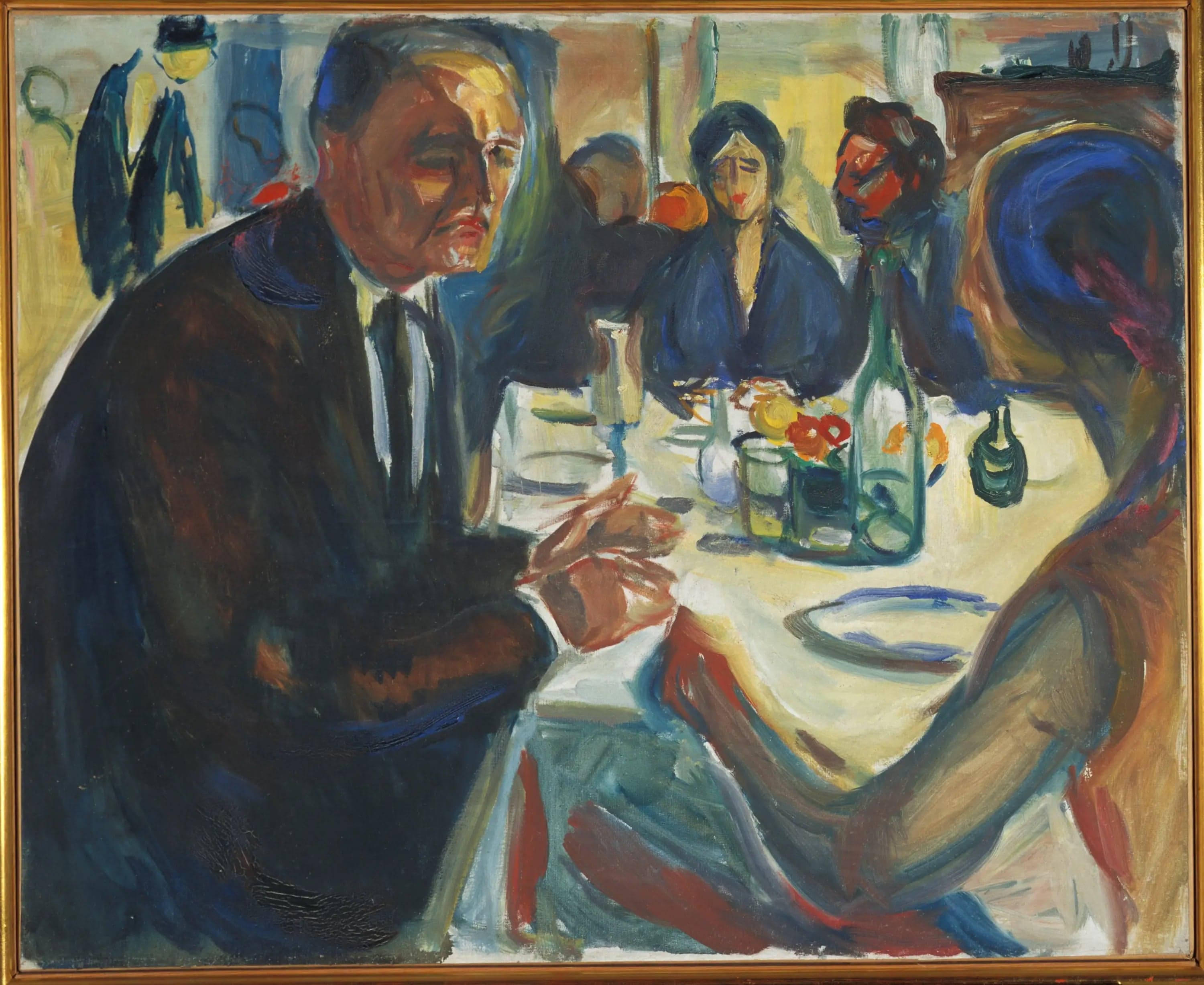
Self-Portrait at the Wedding Table
- Original dimensions
- 64.5 x 79 cm
- Museum
- Munch Museum
- Year
- 1925
Scene depicted
This canvas features Munch himself, seated at a table, surrounded by symbolic objects evoking marriage. The composition is charged with emotional tension, reflecting the artist's anxieties and desires related to union. This painting thus becomes a profound exploration of solitude, love, and expectations, echoing the internal struggle between societal duty and personal desire.
Historical context
Created in Oslo, this painting is the result of a period rich in emotions for Munch, one of the masters of symbolism . Revealing a disturbing intimacy, this canvas is part of the expressionist movement, where the human soul and its complexities are highlighted. The Munch Museum houses this masterpiece , providing visitors access to the psychological depth of the work.
Place in the artist's career
Expressing a turning point in his career, the Self-Portrait at the Wedding Table stands as a testament to an artist of emotional maturity. Compared to other works such as "The Scream" and "The Madonna," this painting reveals an evolution through the prism of human relationships. Woven with tensions and personal discoveries, each work testifies to Munch's disarming journey.
Anecdote
In his words, Munch is said to have stated: “Painting is for me a cry of the soul, a need to express what words cannot convey.” The artist drew his inspiration during introspective moments, where the disturbing nature of his personal relationships amalgamated with his art. It is this moment of truth, stemming from an April morning, that reinforced the evocative power of the Self-Portrait at the Wedding Table .
Major exhibitions
Munch og Ekely: 1916-1944