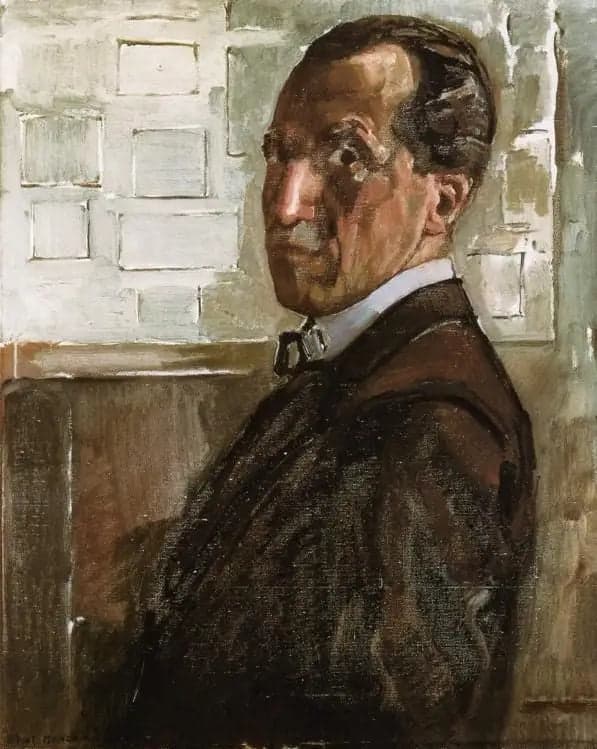
Self-Portrait
- Original dimensions
- 71 x 88 cm
- Museum
- The Hague Museum of Art
- Year
- 1918
Scene depicted
The painting “Self-Portrait” by Piet Mondrian is an exploration of self, a play of lines and colors that conveys not only the artist's face but also his essence. Far from being a simple bodily representation, this canvas illustrates the soul of a creator engaged in a search for truth through abstraction. Primary colors and geometric shapes dominate, heralding an innovative artistic vision.
Historical context
Year: 1918 |BRK| Museum: The Hague Museum of Art |BRK| Dimensions: 71 x 88 cm
Place in the artist's career
Situated at a turning point in his career, “Self-Portrait” symbolizes a pivotal moment for Mondrian. It is a period of maturity where his style evolves considerably. In parallel, his works such as “Composition in Red, Blue and Yellow” and “Broadway Boogie Woogie” illustrate this quest for harmony and balance, revealing the progression of his artistic language.
Anecdote
“I do not paint what I see, but what I feel.” These words spoken by Mondrian resonate in the conception of his masterpiece . Inspired by the soft light of a spring morning in his studio, he translates onto his canvas an inner quest, a reflection on his identity and his positioning in a world undergoing change.