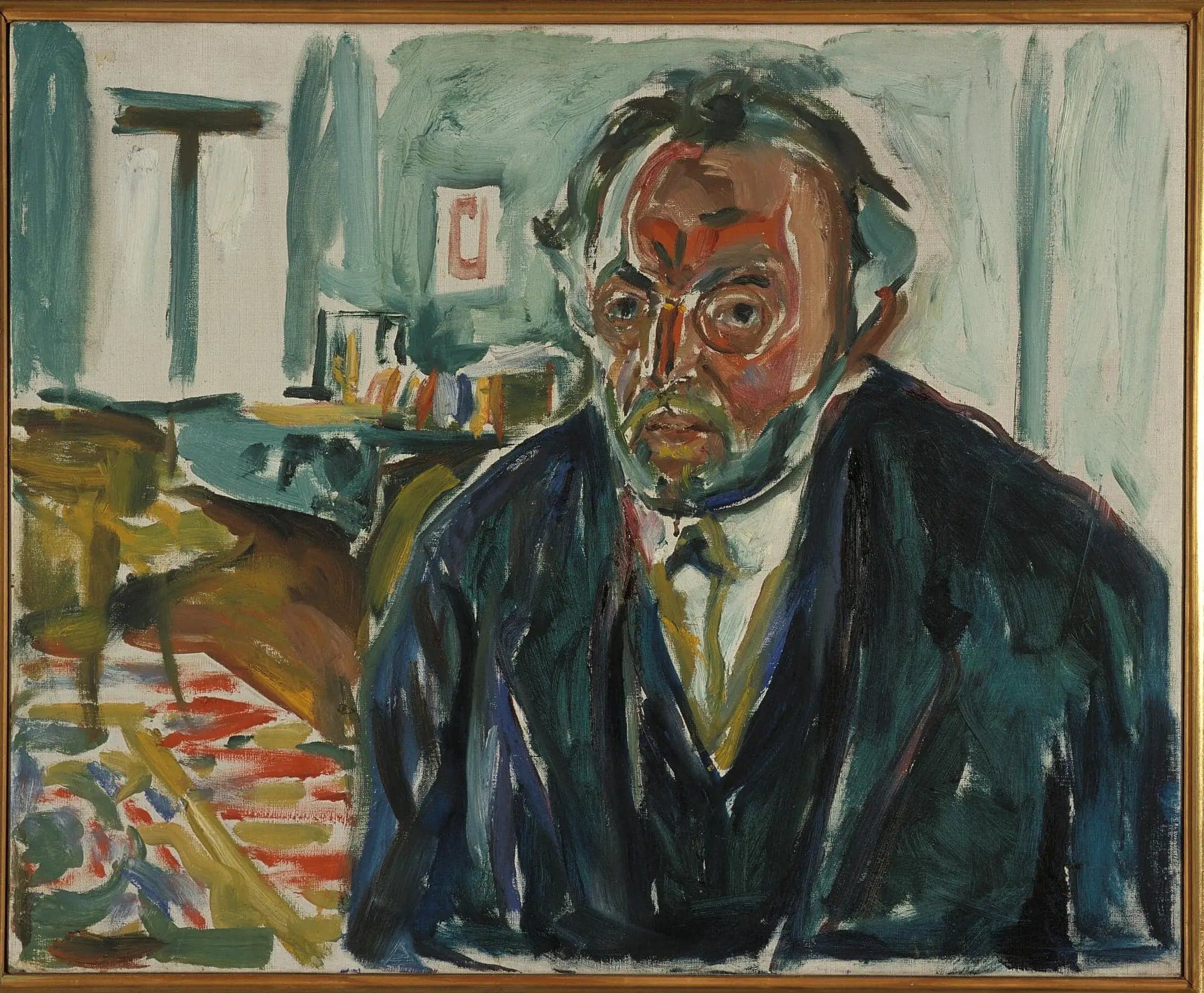
Self-Portrait after the Spanish Flu
- Original dimensions
- 73 x 59 cm
- Museum
- Munch Museum
- Year
- 1919
Scene depicted
In this masterpiece , Munch depicts himself with an emaciated face, eyes filled with fatigue and defiance. The canvas illustrates the winding path the artist took after his illness, encapsulating both human vulnerability and inner strength. Through the intensity of colors and the distortion of forms, Munch transcends the simple self-portrait to create a pictorial work rich in universal emotions.
Historical context
Created in 1919 in the heart of Oslo, this painting is a powerful testament to a time troubled by the Spanish flu. Munch, a beacon of the expressionist movement, invites us to dive into a world filled with intense sensations and raw emotions. His canvas is now preserved at the Munch Museum, a true sanctuary of his works and a reflection of an endlessly renewed inspiration.
Place in the artist's career
This canvas is positioned at a key moment in the career of Edvard Munch , marking the transition to a period of artistic evolution. Alongside other paintings like “The Scream” and “The Madonna,” the self-portrait highlights the artist's eternal quest to represent the complexity of the human soul, paying homage to a deeply personal and emotional aesthetic.
Anecdote
“Every brushstroke on this canvas is a heartbeat of the soul. It is where life and suffering intersect.” These words from Munch resonate like an echo of the moment he stood before his mirror, contemplating the devastating effects of illness on him. This painting is much more than a simple self-portrait; it crystallizes the struggle between suffering and resilience, making the canvas all the more powerful.
Major exhibitions
Munch og Ekely: 1916-1944