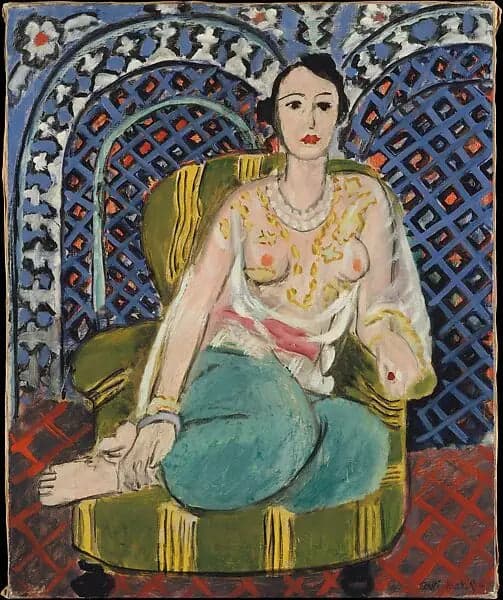
Seated Odalisque
- Original dimensions
- 60 x 73 cm
- Museum
- Metropolitan Museum of Art
- Year
- 1926
Scene depicted
The painting Odalisque assise transports us into a universe of vitality and escape, where a woman lounges in an atmosphere of serenity. Captured in a delicate pose, she embodies a fusion of tranquility and invitation, her gaze lost in thoughts likely tinged with daydreaming. The composition, delicately arranged, evokes a space that is both intimate and open, where each element harmoniously interlocks to create an atmosphere where inspiration mingles with escape.
Historical context
Created in the vibrant city of Paris, at the heart of the 1920s, Odalisque assise embodies the peak of the Fauvist movement. This iconic painting , which enriches the collections of the Metropolitan Museum of Art , still resonates with the avant-garde spirit of its time, a moment when colors broke free from traditional constraints, transforming each canvas into a territory of artistic freedom.
Place in the artist's career
Odalisque assise represents a pivot in Matisse's career, marking a moment of artistic maturity. After the Fauvist experiments of La Danse and the colorful lyricism of Le Bonheur de Vivre , this canvas reveals a mastery of forms and volumes, an unceasing quest for beauty and harmony. Each painting by Matisse testifies to his evolution towards depth and emotional complexity, laying the foundations of a body of work that continues to fascinate and inspire.
Anecdote
Henri Matisse once reportedly whispered: "Color must be a sensation, not a concept." This sentiment guided him as he walked through the gardens of his friend's villa in Nice, inspired by the shapes and lights dancing under the warm sun of southern France. It is from this space of softness and harmony that the elusive emotion of Odalisque assise emerges, where each brushstroke evokes delicate sensuality and genuine intimacy.