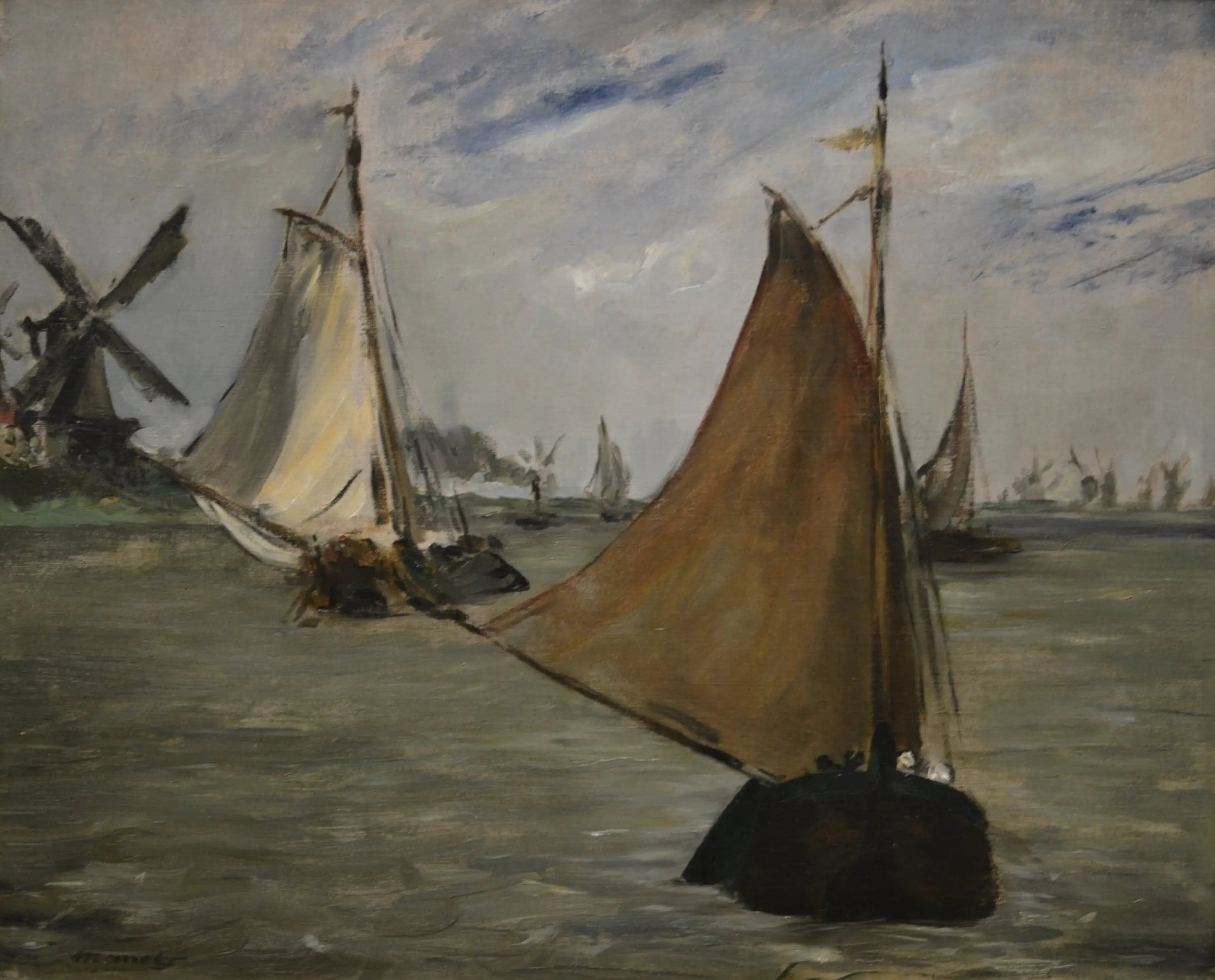
Seascape in Holland
- Original dimensions
- 60.3 x 50 cm
- Museum
- Philadelphia Museum of Art
- Year
- 1872
Scene depicted
This painting illustrates a fascinating maritime panorama where the craftsmanship of traditional boats meets the softness of the climate. The scene is rhythmically punctuated by the dance of the waves, reflecting the light of the sky in a harmony of blues and whites. The composition immerses us in a reflection on man and nature, evoking Holland's rich maritime history.
Historical context
Created in the heart of the 19th century, during a pivotal moment in the history of art, Manet's painting "Marine in Holland" is part of the Impressionist movement, while being a bold reinterpretation of maritime traditions. This iconic canvas showcases Dutch splendor from a French shore, while today it is carefully preserved at the Philadelphia Museum of Art , revealing its dimensions that capture the vast tranquility of the waters.
Place in the artist's career
"Marine in Holland" marks a turning point in Manet's career, illustrating his growing mastery of Impressionist nuances. Alongside "Luncheon on the Grass" and "Olympia," this work demonstrates his stylistic evolution, oscillating between boldness and tradition, serving as a bridge between naturalism and modern art.
Anecdote
As Manet once confessed: “Art should be the reflection of a fleeting moment, a window open to the soul.” It is in this quest to capture a fleeting moment that he captured the magic of a morning where the sun rises, illuminating the white sails of the boats, creating an atmosphere imbued with serenity and promise.