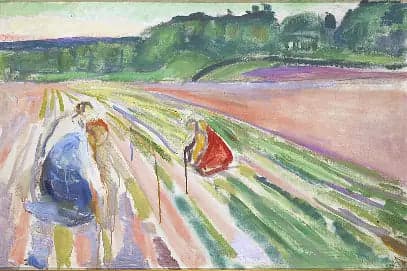
Scarification
- Original dimensions
- 100 x 67 cm
- Museum
- Moderna Museet
- Year
- 1918
Scene depicted
This striking canvas immerses us in a scene of agricultural work. Amidst the lush nature, the worker attempts to tame the wild earth. The strokes of the hoe evoke not only physical effort but also the deep connection that binds man to nature.
Historical context
Created in 1918, at the heart of the artistic revolution of the early 20th century, this painting is emblematic of the tormented soul of Edvard Munch , a Norwegian artist based in Oslo. Aligned with symbolism and expressionism , Sarclage stands out for its emotional depth. Currently, this canvas is located at Moderna Museet, Stockholm, where it continues to captivate minds.
Place in the artist's career
Sarclage represents a key milestone in Munch's career, illustrating his transition to a more mature style. It is positioned between The Scream and The Madonna , showcasing an evolution in the treatment of complex emotions and themes of nature.
Anecdote
Munch once stated: "Every work of art is a window into the artist's soul." On a spring morning in the countryside, he encounters a farmer immersed in his labor. This moment, imbued with authenticity, became the source of inspiration behind Sarclage , a manifesto of human struggle.