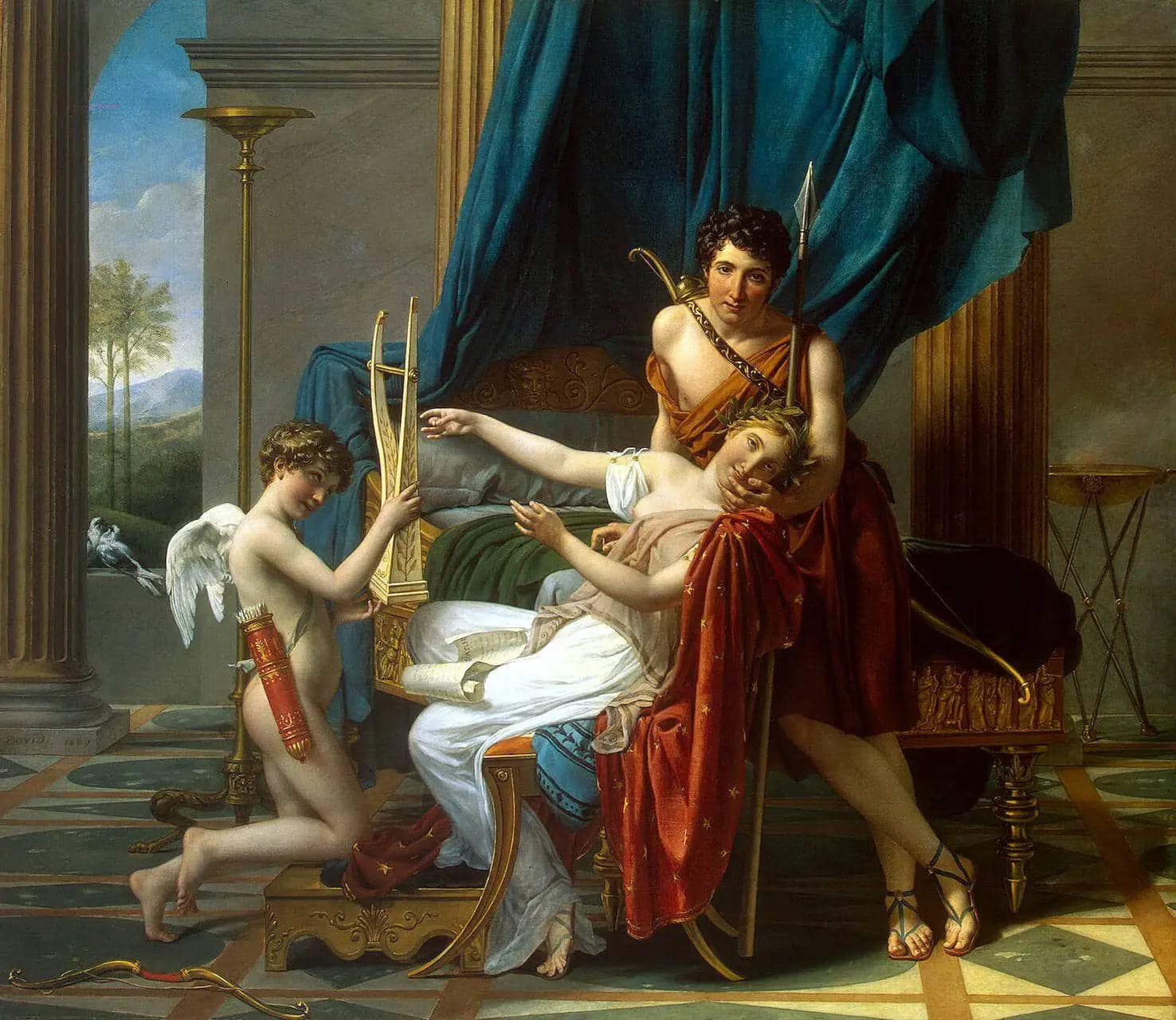
Sapho, Phaon and Love - Jacques
- Original dimensions
- 262 x 225.3 cm
- Movement
- Neoclassicism
- Museum
- Hermitage Museum
- Year
- 1809
Scene depicted
The composition of Sappho, Phaon and Love represents a scene of poignant intensity. It illustrates the tragic union between Sappho, a poetess from Lesbos, and Phaon, a young man who embodies ephemeral beauty. More than just a painting , this canvas evokes a universe of feelings where passion and despair coexist, weaving a narrative that endures beyond the centuries.
Historical context
This masterpiece was born in France, in the heart of the neoclassical era, marked by a return to the ideals of Antiquity. Commissioned by the enlightened taste of an audience eager for timeless beauties, it invites us to revisit a tragic and sublime love story. Today, this iconic painting rests at the Hermitage Museum , a prestigious setting that enhances its grand dimensions.
Place in the artist's career
Sappho, Phaon and Love is part of a lineage of significant masterpieces, representing a pinnacle in David's career. Just before, he painted " The Oath of the Horatii ", a painting that highlights masculine bravery. This canvas models the neoclassical spirit while hinting at the beginnings of romanticism .
Anecdote
Imagine Jacques-Louis David , in the early morning, facing his easel. "Passion manifests in every brushstroke," he said. It is in this quest for emotion that this pictorial work came to life. David captured moments of introspection, bursts of heart, making palpable the melancholy and beauty offered by love.