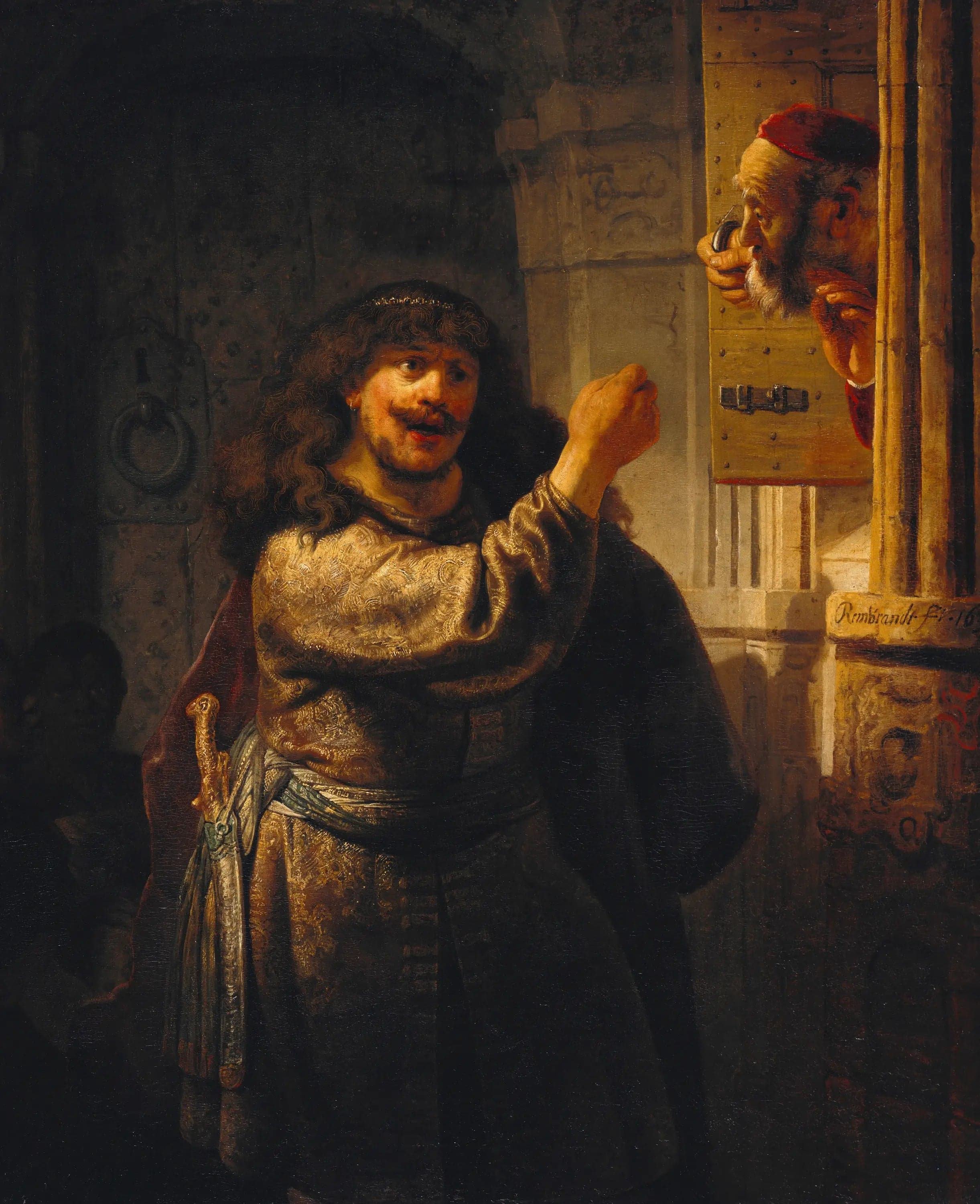
Samson Threatens His Father-in-Law
- Original dimensions
- 130.5 x 158.5 cm
- Movement
- Dutch Golden Age of painting
- Museum
- Gemäldegalerie
- Year
- 1635
Scene depicted
This painting illustrates an intense moment from the Bible, where Samson, a powerful character, faces his father-in-law, a conversation filled with tension. The expressions of the characters are striking, conveying a palpable drama through gestures and glances, making this painting of unparalleled emotional depth.
Historical context
This masterpiece was created in 1635, in Amsterdam, during a flourishing period of the 17th century when Dutch art reached its peak. Rembrandt , an iconic figure of this era, captured the soul of his time through this vibrant canvas. The painting is currently housed in the Gemäldegalerie, where it dazzles visitors with its imposing size and narrative brilliance.
Place in the artist's career
Set in a period of artistic maturation, "Samson threatens his father-in-law" marks a turning point in Rembrandt 's career. After his famous painting "The Night Watch", this work represents the pinnacle of his mastery, also paralleling "Judith and Holofernes", where one observes an evolution in the technique of shadow and light.
Anecdote
“Art must be a reflection of humanity. Every moment is a painting waiting to be saved.” It is in this quest for truth that Rembrandt awakened to the idea of his iconic painting . One misty morning, while wandering the streets of Amsterdam, he encountered an emotional face that could only inspire him to immortalize the tragic struggle of Samson. A meeting that allows one to feel the strength of humanity in his painting .