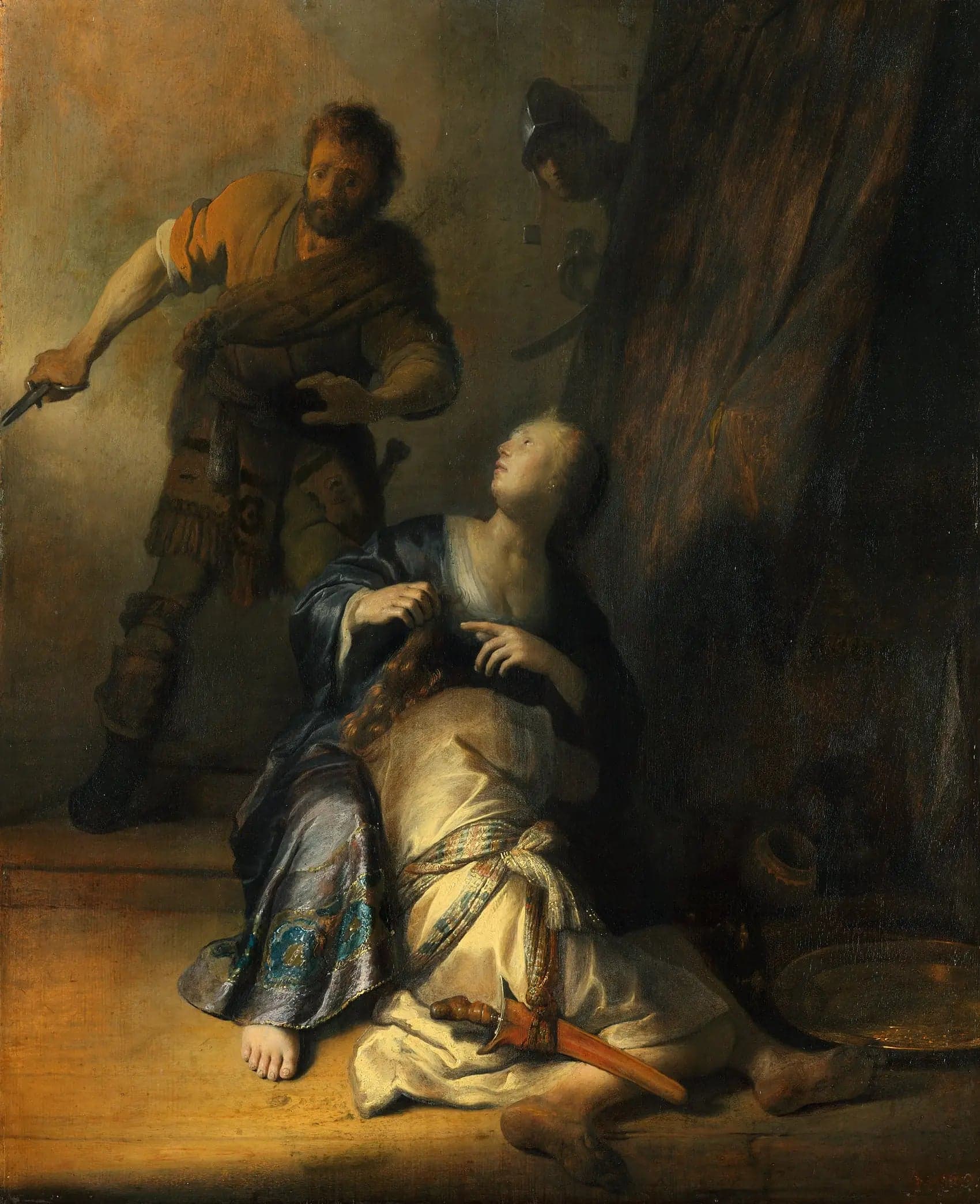
Samson betrayed by Delilah
- Original dimensions
- 50.1 x 61.3 cm
- Movement
- Dutch Golden Age
- Museum
- Gemäldegalerie
- Year
- 1628
Scene depicted
In this magnificent composition , Rembrandt depicts the crucial moment when Samson, struck by Dalila's betrayal, finds himself stripped of his strength. The carefully orchestrated details of the scene illustrate not only physical pain but also psychological anguish. The brilliance of the expressions and the intensity of the gazes immerse the viewer in an atmosphere of palpable tension, where Samson's humanity resonates across the centuries.
Historical context
Created in 1628 in Amsterdam, during the flourishing of the Dutch Golden Age, this canvas testifies to the ingenuity of Rembrandt . Currently housed in the Gemäldegalerie, this painting measuring 50.1 x 61.3 cm offers a window into a world that is both tragic and touching, where light and shadow dance on Samson's face, symbolizing his painful fate.
Place in the artist's career
This painting is part of a period of maturity for Rembrandt , where he succeeded in combining technique and emotion. Alongside his famous painting “The Night Watch” and “Girl with a Pearl Earring,” one observes a fascinating evolution in the representation of human figures and the play of shadow. With “Samson trahi par Dalila,” he surpasses his previous works by offering unparalleled emotional depth.
Anecdote
“Light is the key to the soul,” said Rembrandt . Imagine him, sitting by his window, one spring morning, observing the play of light reflecting on his studio. This inspiration came to him, evoking the struggle and passion of Samson, capturing the eternal tension between strength and betrayal within his painting .
Major exhibitions
Rembrandt . Schilderijen bijeengebracht ter gelegenheid van de inhuldiging van Hare Majesteit Koningin Wilhelmina, 8 September-31 October 1898