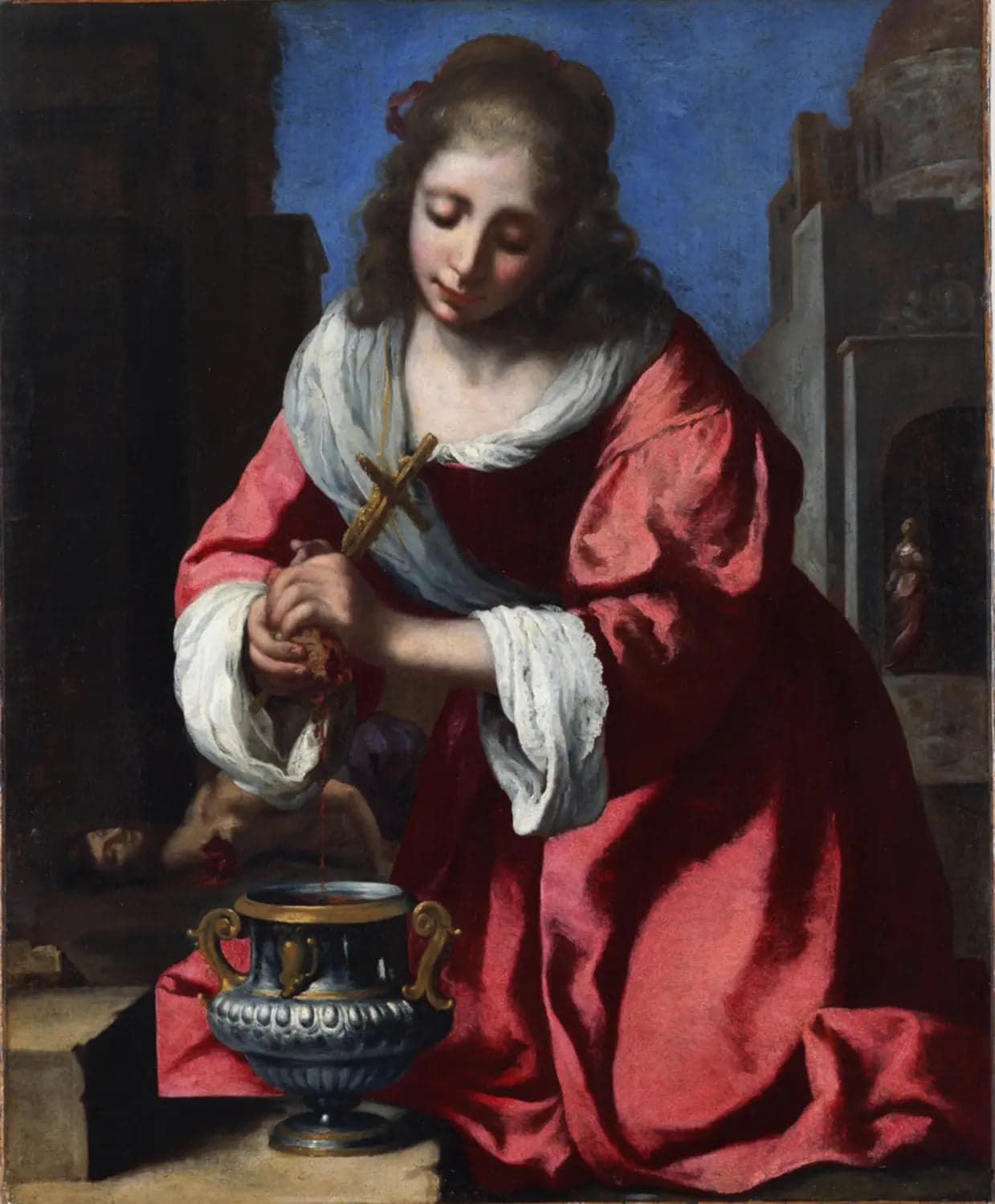
Saint Praxedes
- Original dimensions
- 82.6 x 101.6 cm
- Movement
- Mannerism
- Museum
- National Museum of Western Art
- Year
- 1655
Scene depicted
“Sainte Praxède” illustrates a scene imbued with divine serenity, where the saint is surrounded by symbols of faith and piety. Every detail of this canvas is rich in meaning, immersing the viewer in a timeless moment, a silent communion between the human and the divine. Textures and light intertwine to create a captivating atmosphere.
Historical context
Created in 1655, in the city of Delft, this painting is part of the Mannerism movement, characterized by its refined details and elegance. At that time, Holland was an artistic hub, and Vermeer's canvas evokes a moment of vibrant cultural wealth. Today, this painting is preserved at the National Museum of Western Art , testifying to the exceptional mastery of its creator.
Place in the artist's career
“Sainte Praxède” marks a pivotal moment in Vermeer’s career, combining mastered technique and powerful emotion. It dialogues with other iconic paintings such as “The Lace Maker” and “View of Delft,” illuminating his stylistic evolution. This painting is not only a reflection of his genius but also an exploration of light and space.
Anecdote
“Art is a breath of light,” said Vermeer, inspired by the softness of the early morning rays entering his studio. Imagine a spring morning in Delft, where subtle light dances on the walls, and inspiration springs from every corner of the street. This is how the painting “Sainte Praxède” transforms into a deeply evocative work.
Major exhibitions
Vermeer