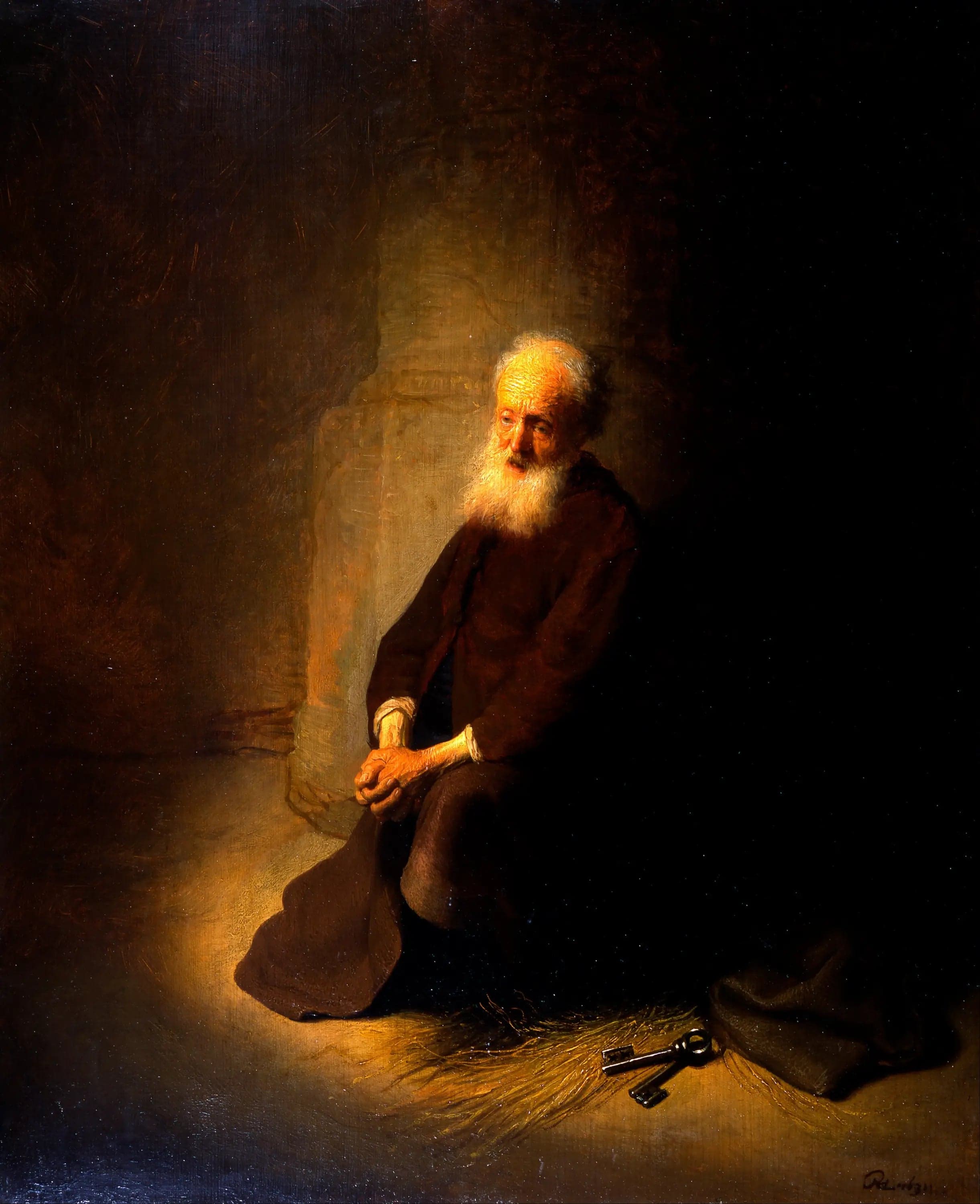
Saint Peter in Prison
- Original dimensions
- 47.8 x 59 cm
- Movement
- Dutch Golden Age
- Museum
- Israel Museum
- Year
- 1631
Scene depicted
The scene of the painting “Saint Pierre en prison” depicts the moment when the apostle Peter, captured, finds himself sitting in heavy darkness. The chains that hold him evoke a sense of palpable tension, while a soft light radiates from the angelic figure who is about to free him. This moment, both dramatic and imbued with serenity, illustrates Saint Peter's unwavering faith in the face of the storm of his destiny.
Historical context
Created in the heart of the Netherlands in the 17th century, Saint Pierre en prison is an emblematic work that emerged during the Dutch Golden Age of painting. In a time of artistic and cultural flourishing, this painting reflects a historical context where religion and art merge to give birth to masterpieces of unparalleled emotional depth. The painting is currently housed in the Israel Museum , where each gaze contributes to its legend. With its dimensions of 47.8 x 59 cm, this canvas imposes a captivating presence.
Place in the artist's career
This painting is situated at the beginning of Rembrandt 's career, a phase where the artist was still experimenting with different styles and techniques. In parallel with other paintings like “The Night Watch” and “The Anatomy Lesson of Dr. Tulp,” a marked evolution is observed, both stylistically and emotionally. With Saint Pierre en prison , he asserts himself as a master of chiaroscuro and human introspection.
Anecdote
“Light is both the heart and soul of my canvas,” is said to have declared Rembrandt . On a sunny morning, as the light made its way through veils of mist, the artist observed life blossoming around him. It was in an alley in Leiden that the inspiration for this masterpiece was born, where he captured the essence of a strong humanity in distress, transforming the painting into a high place of emotions.