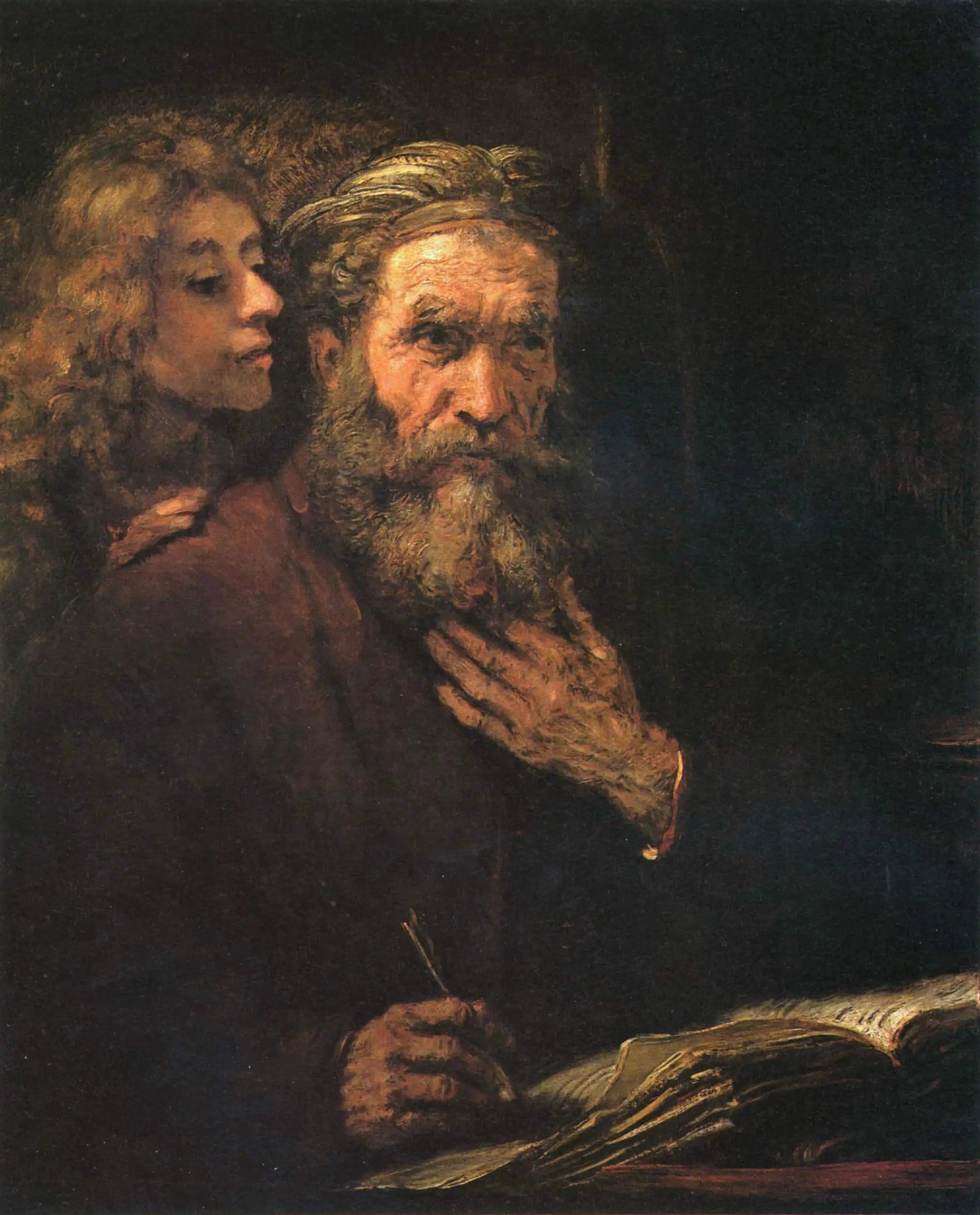
Saint Matthew and the Angel
- Original dimensions
- 81 x 96 cm
- Movement
- golden age of Dutch painting
- Museum
- room 844
- Year
- 1661
Scene depicted
This majestic painting illustrates a moment of spiritual elevation, where the angel comes to bring divine inspiration to Saint Mathieu, revealing a deep communion between the sacred and the profane. Through delicate gestures and subtle luminosity, Rembrandt manages to imbue the scene with a mystical atmosphere, where every detail echoes a universal story of illumination.
Historical context
Created in the heart of the golden age of Dutch painting, in 1661, the painting titled Saint Mathieu et l'ange by Rembrandt finds its anchor in Amsterdam, a vibrant city rich in creativity. This canvas , which can be admired in room 844 of a prestigious museum, measures 81 x 96 cm. The work embodies the very essence of the spirituality of its time, while revealing the virtuosity of the master.
Place in the artist's career
Saint Mathieu et l'ange positions itself in the career of Rembrandt as a stylistic peak, a declaration of emotional intensity and technical mastery. Alongside other famous paintings such as The Night Watch and The Return of the Prodigal Son , this painting reveals an evolution in his use of light and shadow, offering poignant illumination on human emotion.
Anecdote
Rembrandt , whose passion for art was intertwined with a deep empathy for his subjects, once declared: "Art is not limited to what one sees, but to what one feels." In painting Saint Mathieu et l'ange , he allowed himself to be overwhelmed by the soft light of a spring morning, capturing in each brushstroke the vibrant soul of his model, transforming a simple painting into a true work of emotion.