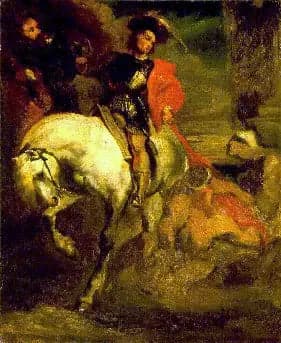
Saint Martin sharing his cloak with a poor man
- Original dimensions
- 38 x 46 cm
- Museum
- Royal Museums of Fine Arts of Belgium
- Year
- 1812
Scene depicted
This canvas powerfully illustrates the poignant moment when Saint Martin, a Roman soldier, generously shares his cloak with a poor man, a scene filled with compassion and solidarity. The representation of this simple action, yet of immense emotional depth, inspires reflection on sharing and helping the less fortunate, offering a timeless significance to the work.
Historical context
Created in 1812, this painting emblematic of the romantic movement has its roots in Brussels, within the Royal Museums of Fine Arts of Belgium . The era, marked by social tension and a quest for intense emotions, saw the birth of this canvas that testifies to exemplary humanism. This masterpiece, displayed in the Belgian capital, invites a rediscovery of a powerful moment of human compassion.
Place in the artist's career
This canvas marks a significant milestone in the career of Théodore Géricault , situated at the crossroads of his remarkable beginnings and his growing stylistic mastery. In the shadow of La Peau de chagrin and The Raft of the Medusa , this canvas testifies to both technical and emotional evolution, placing Géricault brightly in the history of art.
Anecdote
“Every brushstroke is a dialogue with the soul, a call to rediscover humanity,” Géricault might have said while contemplating the scene on a warm Brussels morning, where he encountered a face bruised by the cold. It is in this alley, bathed in light, that the inspiration for the painting burst forth, intertwined with the social commitment that defined part of his work.