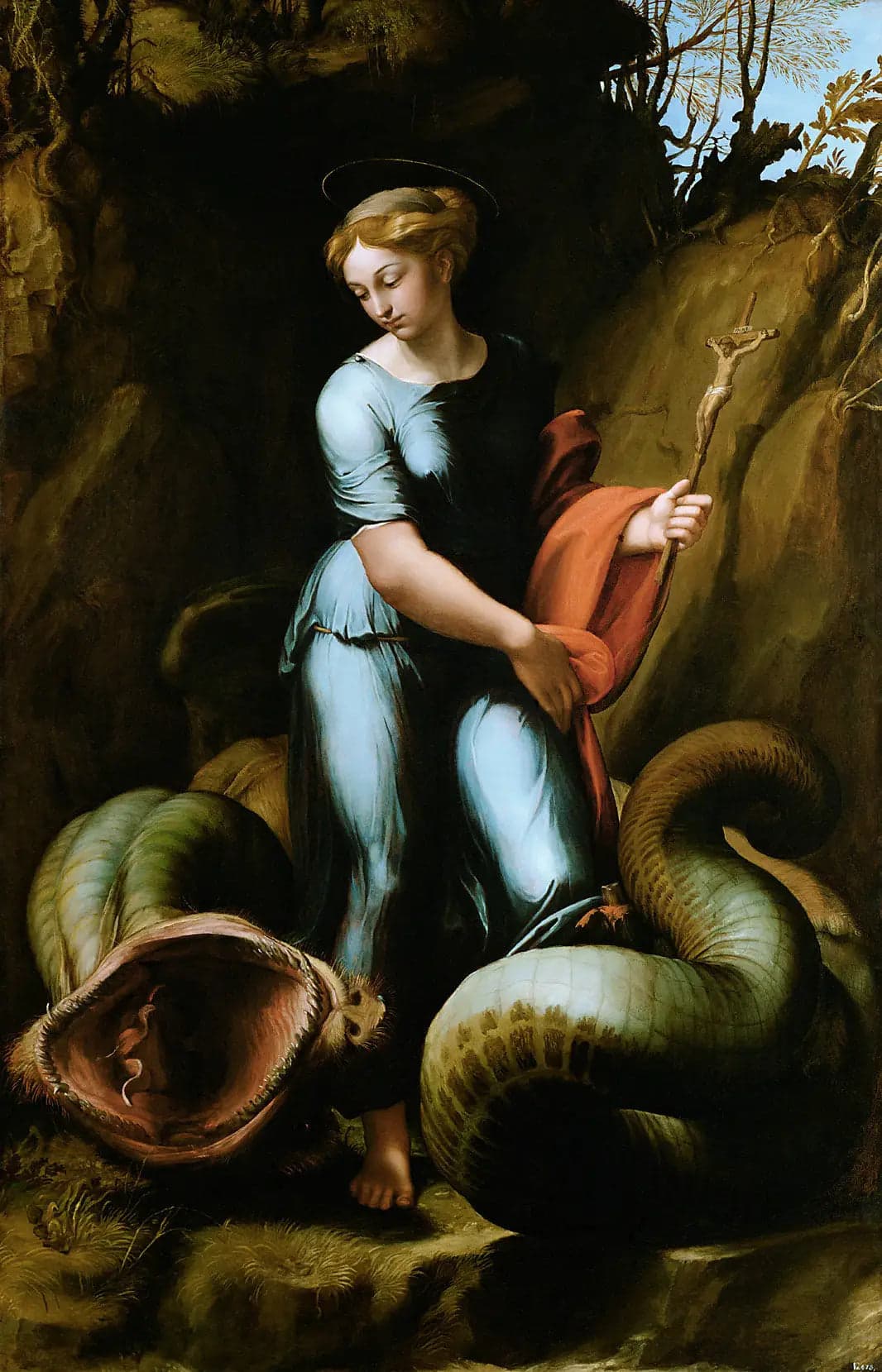
Saint Margaret
- Original dimensions
- 122 x 178 cm
- Movement
- Italian Renaissance
- Museum
- room 710
- Year
- 1518
Scene depicted
In this canvas , Raphael glorifies the figure of Saint Margaret, symbolizing resistance and faith. The painting splendidly illustrates the story of her martyrdom, where the dragon, a figure of evil, represents the eternal struggle between good and evil, hope and despair. The meticulous details of the scene hypnotize, enveloping you in a sacred atmosphere, where each element seems to vibrate with its own life.
Historical context
Created in 1518, in the flourishing context of the Italian Renaissance in Rome, the painting named Saint Margaret stands out for its captivating atmosphere, a reflection of the time when sacred art merged with aesthetic innovations. Currently displayed in room 710, this brilliant canvas of 122 x 178 cm interacts with light and space, bringing a unique spiritual essence to the surrounding environment.
Place in the artist's career
Saint Margaret marks a major turning point in Raphael's career, revealing his mature style. This canvas is part of a phase of divine exploration of the human form, comparable to the Exaltation of the Holy Cross and the Sistine Madonna, highlighting his technical and emotional evolution in the face of the complexity of artistic compositions.
Anecdote
“Beauty is the light of the soul, it must dance on the canvas.” These words, imaginary yet evocative, may have emerged in Raphael's mind one bright morning as he observed nature. The inspiration for this masterpiece would have arisen from a chance encounter, where an innocent face seen in a sunlit alley brought to life the depth of the soul of his painting .