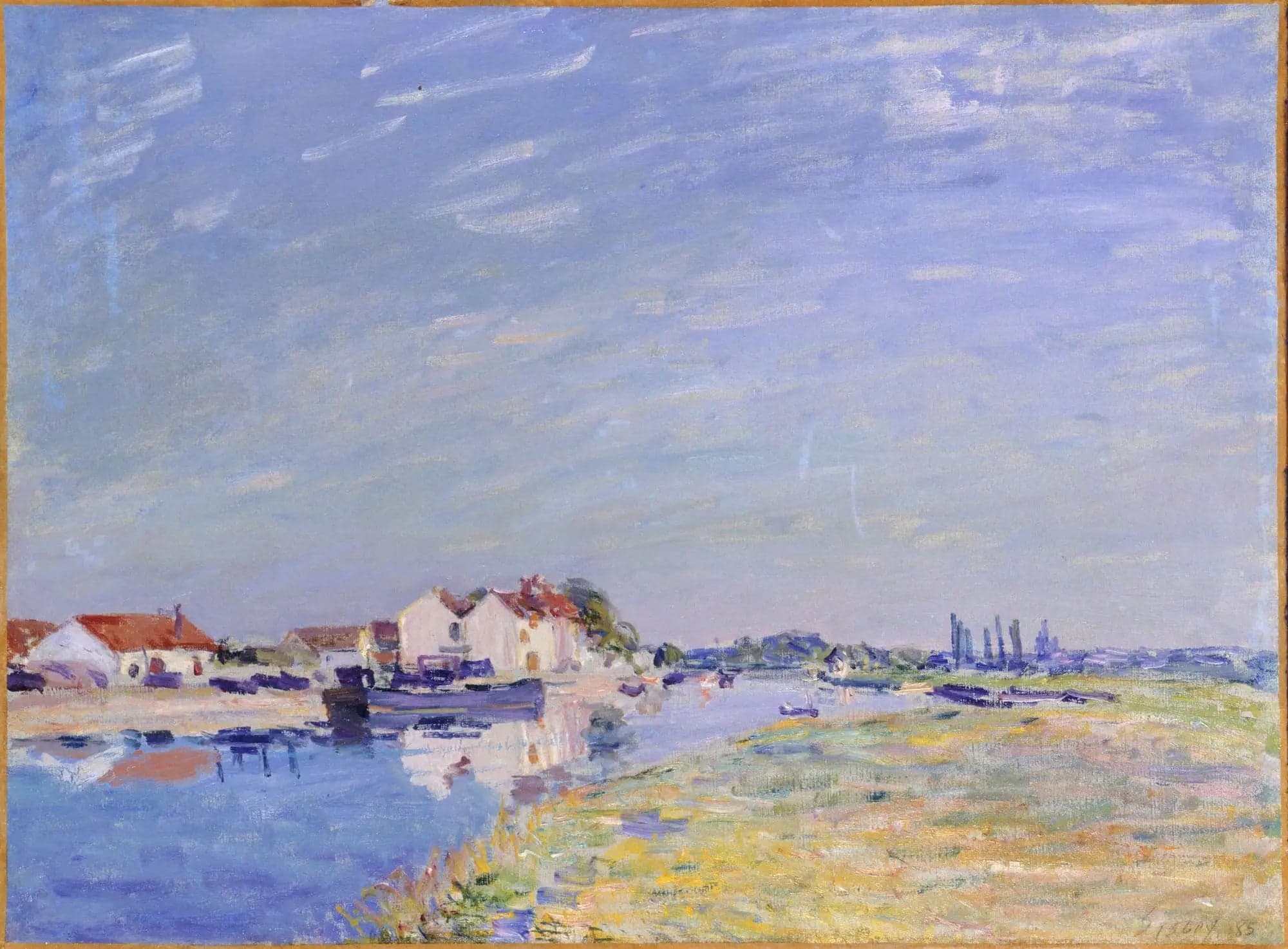
Saint Mammès
- Original dimensions
- 79.7 x 98.7 cm
- Museum
- Princeton University Art Museum
- Year
- 1885
Scene depicted
This painting depicts a moment from everyday life, at the confluence of rivers, where light and shadows dance on the calm water. The reflections of a sparkling blue sky blend with the surrounding greenery, inviting the viewer to share a moment of serenity by the water. The skillfully orchestrated composition reveals Sisley's mastery in rendering Impressionist atmospheres.
Historical context
Created in 1885, this canvas bears witness to the Impressionist movements of the late 19th century. Alfred Sisley , a leading figure of the movement, painted this captivating work in an evocative natural setting near Saint Mammès, a small village in France. Today, the painting is housed in the Princeton University Art Museum , where its magnificence is preserved and admired.
Place in the artist's career
Saint Mammès is considered one of the peaks of Alfred Sisley's career. This work is part of a period of artistic maturity, where his oil painting techniques reach new heights. Compared to other creations such as Le Pont de Moret (1896) and Le Canal de la Vigne (1886), one can observe the evolution of his style, moving from monochromes to bolder compositions.
Anecdote
It is said that Alfred Sisley found inspiration for this masterpiece on a gentle spring morning, as a light breeze caressed the leaves, creating a melody that was both soothing and dynamic. "Nature is my only true master," he is said to have murmured, thus illustrating his dedication to this vibrant painting .