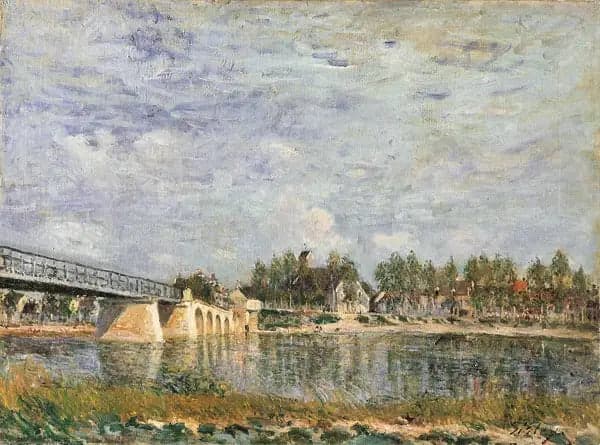
Saint-Mammès
- Original dimensions
- 73.2 x 54.6 cm
- Museum
- Philadelphia Museum of Art
- Year
- 1881
Scene depicted
The scene illustrated in the painting “Saint-Mammès” transports the viewer to the banks of the Seine, where boats glide gently over the peaceful waters. The dancing reflections of the sky blend with the shades of greenery, evoking a deep tranquility. A daily spectacle of the shores, animated by delicate light, Sisley depicts a tableau of calm and serenity, while playing with shadows near the leafy trees. This work thus manages to capture the very essence of rural life, paying homage to the simple beauty of nature.
Historical context
Created in 1881, this iconic canvas by Alfred Sisley is part of the Impressionist movement, an artistic current that revolutionized painting in the beautiful region of Saint-Mammès. At the dawn of the Belle Époque, Sisley captures with unprecedented delicacy a fragment of the peaceful life of a French village. Currently exhibited at the Philadelphia Museum of Art , this pictorial work, measuring 73.2 x 54.6 cm, offers a poignant testimony to the ephemeral beauty of nature.
Place in the artist's career
“Saint-Mammès” marks an emblematic milestone in the career of Alfred Sisley , a strong testament to his Impressionist style. This painting is part of his maturity period, revealing a perfect balance between light and color. It can be paralleled with “The Bridge at Moret” and “The Sèvre at Saint-Mammès,” all three exemplary of a technical evolution that reflects an ever-deepening commitment to light and movement.
Anecdote
“Every brushstroke is a note of music in the symphony of nature,” said Sisley, reflecting on his masterpiece. Inspired by a spring morning, he painted this tranquil scene, where the whisper of the wind in the trees and the gentle glimmer of light invite escape. Thus, this painting becomes a reflection of a suspended moment, a true celebration of the beauty of the world.