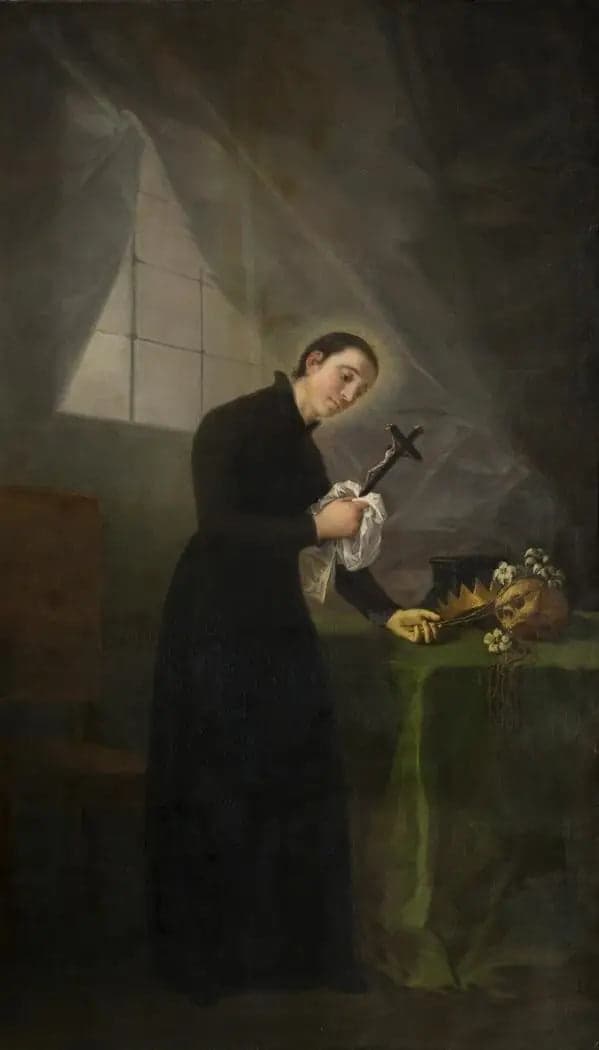
Saint Louis of Gonzaga
- Original dimensions
- 160 x 261 cm
- Museum
- Museum of Zaragoza
- Year
- 1798
Scene depicted
Goya's canvas "San Luis Gonzaga" evokes the spiritual and heroic dedication of a young saint, representing the selflessness and asceticism that characterize religious life. The pictorial work shows San Luis, dressed in his monk's robe, surrounded by elements that underscore his commitment, like a beacon in a sea of doubts, seeking to convey a message of purity and sacrifice to each of those who contemplate him.
Historical context
Created in 1798, this painting is rooted in the rich cultural context of the city of Zaragoza, Spain. Bearing the marks of the artistic movement of romanticism that characterizes it, Goya's canvas illustrates a period of profound upheaval in Spanish and European history, where each brushstroke resonates with the echoes of struggles for freedom. Standing out in the collections of the Museum of Zaragoza, this canvas displays impressive dimensions that capture the viewer's gaze.
Place in the artist's career
This canvas , created during a period marked by Goya's stylistic evolution, represents a significant turning point. It positions itself between "La Maja Desnuda" and "The Executions of May 3," reflecting the rise of his sociopolitical and religious concerns. The depth of this painting testifies to an artist in full maturity, skillfully blending technique and emotion.
Anecdote
“In the silence of shadows, I found the light of a new world.” These words, which could be attributed to Goya, resonate as an inspiration for his masterpiece. Imagine him, one spring morning, wandering through the alleys of Zaragoza, where a youthful face captivated him, thus materializing the essence of San Luis Gonzaga. This fleeting moment nourishes the palpable emotion that emanates from this painting .