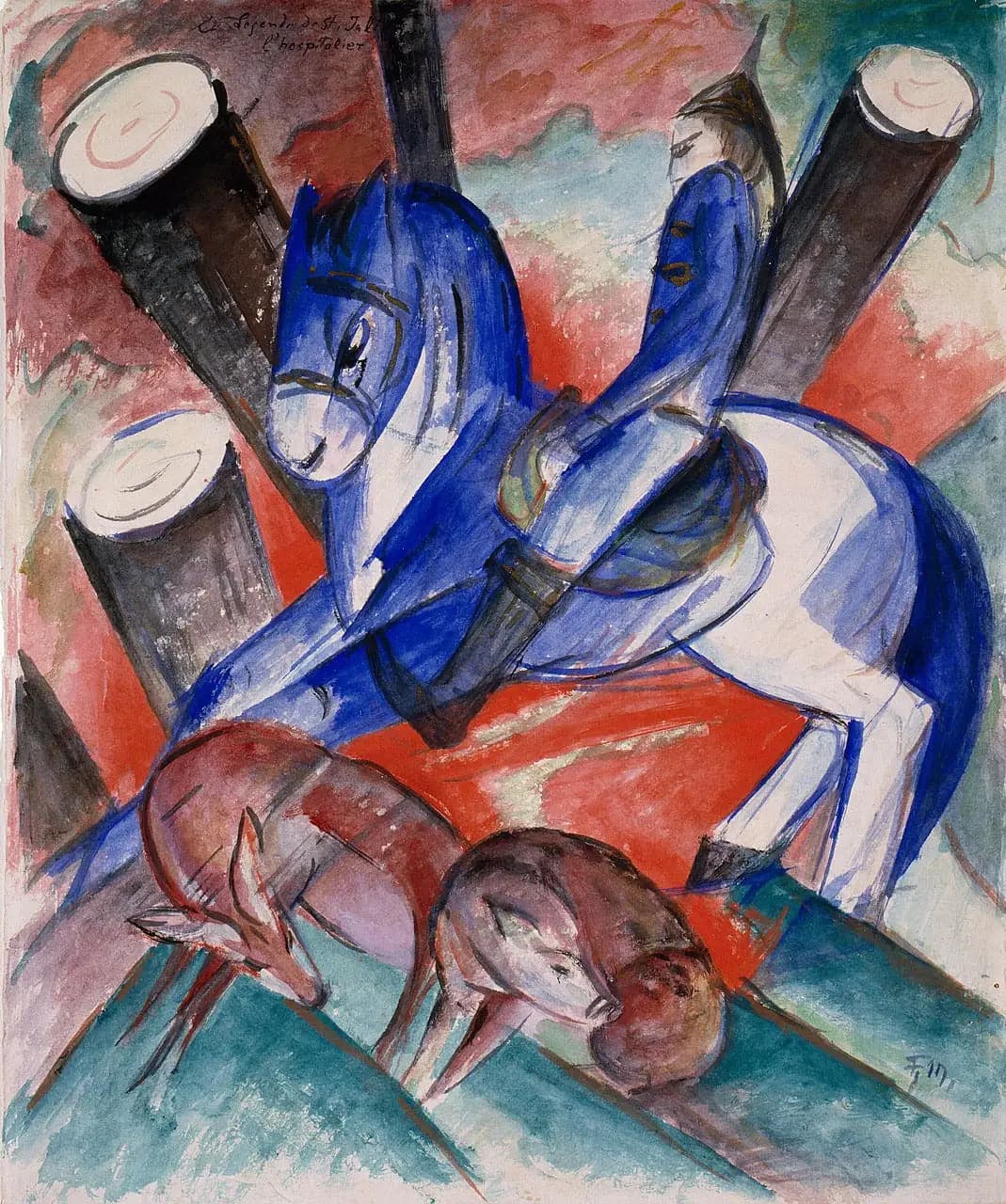
Saint-Julien
- Original dimensions
- 40.2 x 46 cm
- Museum
- Solomon R. Guggenheim Museum
- Year
- 1913
Scene depicted
This painting represents a poetic and almost mystical scene. At the heart of nature, silhouettes vibrant with colors rise and communicate a vital force. The painting bears witness to a meeting between humans and the animal world, a play of glances and movements that transcends realism to touch the essence of spirituality.
Historical context
Created in 1913, in the vibrant Paris of the early 20th century, Saint-Julien is at the heart of the expressionist movement. This iconic painting , currently displayed at the prestigious Solomon R. Guggenheim Museum , is the result of an era when art was meant to explore human emotions through a vibrant and bold palette. The dimensions of 40.2 x 46 cm show a composition that is both intimate and universal.
Place in the artist's career
Situated at a pivotal moment in his career, Saint-Julien embodies the peak of Marc's expressionism . While his first notable painting, Bearer of Light , heralded the beginning of his bold exploration of forms, the canvas of Saint-Julien represents a summit of his artistic maturity, marking a significant evolution from The Large Blue Horse , two years earlier.
Anecdote
“Art is the most beautiful of illusions; it connects us to the soul of things.” This quote from Franz Marc resonates particularly when discussing the genesis of his masterpiece . Inspired by a peaceful morning in nature, Marc captured the essence of silence and daydreaming, an emotion that is powerfully found in the canvas of Saint-Julien.