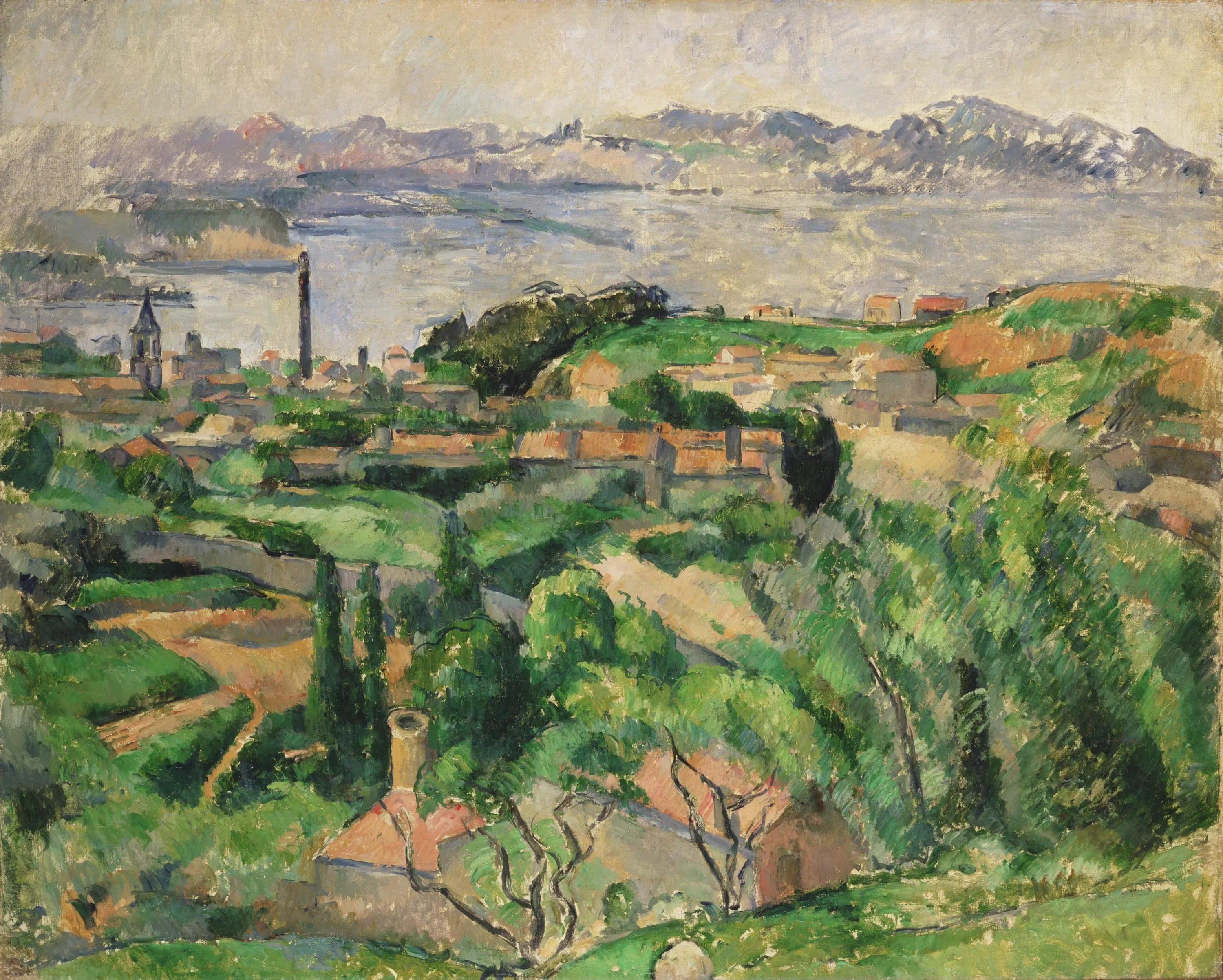
Saint-Henri and the Gulf of Marseille
- Original dimensions
- 81.3 x 65.9 cm
- Museum
- Philadelphia Museum of Art
- Year
- 1883
Scene depicted
Through this canvas , Cézanne immerses us in an idyllic panorama where the village of Saint-Henri harmoniously stands facing the Gulf of Marseille. The gaze discovers lush hills, glimmers of light in the water, and the vivid colors of nature. This composition reveals not only the beauty of the Provençal landscapes but also captures an intimacy and tranquility, paying homage to the magic of this region.
Historical context
Created at the end of the 19th century, in the intoxicating setting of Provence, this painting is emblematic and was influenced by post-impressionism . The work is currently housed in the prestigious Philadelphia Museum of Art , where it continues to fascinate art lovers. This canvas , of generous dimensions, captures the beauty of the Marseille landscape with a concern for detail and an expressiveness unique to Cézanne.
Place in the artist's career
Considered a major work of his maturity, Saint-Henri and the Gulf of Marseille marks a turning point in Cézanne's career. It falls within a period where the artist, already recognized, explores new techniques, parallel to his other notable canvases such as “The Large Bathers” and “Mont Sainte-Victoire,” where one can observe an evolution in his approach to forms and light.
Anecdote
“I desire a painting that pulses like a soul.” These words of Cézanne resonate when observing his masterpiece . Inspired by a sunny morning by the water, the artist understood that nature had to be painted as he perceived it, vibrating with energy and light. Thus, Saint-Henri and the Gulf of Marseille becomes a testament to a moment where art marries the natural world, creating a living experience.