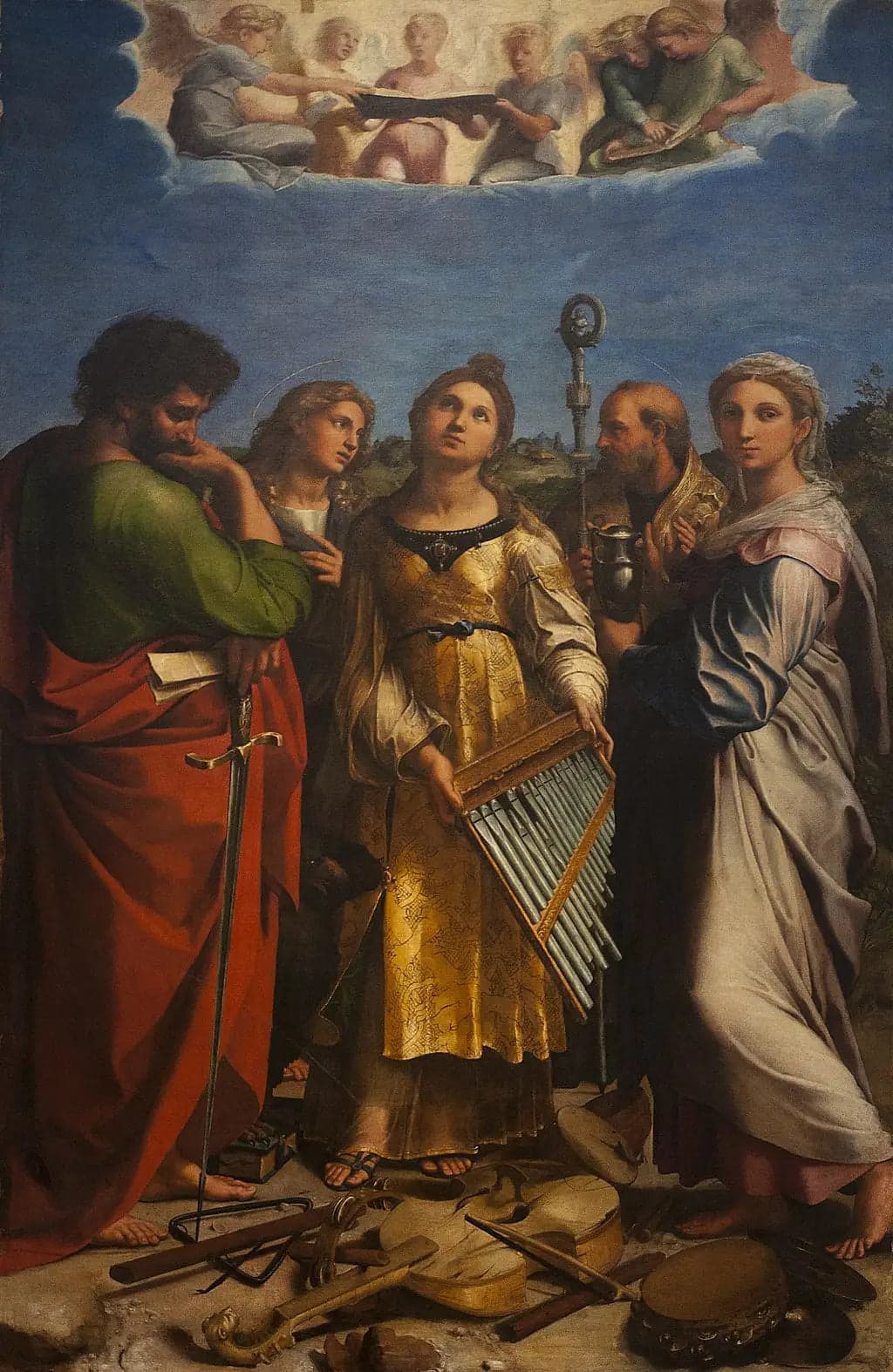
Saint Cecilia
- Original dimensions
- 150 x 238 cm
- Museum
- Not specified
- Year
- 1513
Scene depicted
In this painting , Raphael immortalizes Saint Cecilia amidst a composition rich in symbolism . The painting depicts the saint, holding a musical instrument, surrounded by celestial figures, merging music and spiritual transcendence. Each stroke and each color work together to embody the duality between the sacred and the earthly, connecting art to divinity.
Historical context
Created in 1513, in the artistic heart of the Italian Renaissance , Raphael's painting , Sainte Cécile , goes far beyond a simple canvas . It stands out in a fertile era, where art emerges as a vector of culture and spirituality. The work, which captures the very essence of Saint Cecilia as the patroness of sacred music, is a vibrant tribute to beauty and melody. Although its current location is not specified, this emotional painting has traversed the centuries to captivate the souls of observers.
Place in the artist's career
Sainte Cécile marks an important milestone in Raphael's career. This work testifies to his artistic maturity, following achievements such as the painting of the Madonnas and preceding the iconic painting of the School of Athens . Through these works, we can appreciate the evolution of his style, blending technical virtuosity and deep human emotions.
Anecdote
“I capture light to illuminate the shadow of our existence,” Raphael might have said, contemplating an alley in Florence one spring morning. It is here, immersed in the luminous beauty of the city, that he drew inspiration to create this masterpiece . Illustrating the spiritual depth of Saint Cecilia is to convey a voice of devotion, a message beyond time.