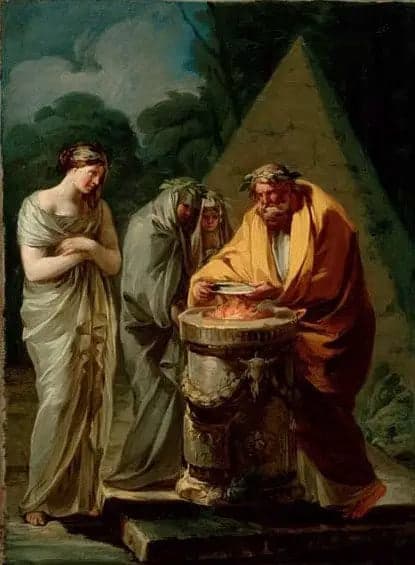
Sacrifice to Vesta
- Original dimensions
- 24 x 32.5 cm
- Museum
- Not specified
- Year
- 1771
Scene depicted
The painting “Sacrifice à Vesta” is not just a simple representation of an ancient rite, but an invitation to dive into a world where spirituality and tradition intertwine. This painting captures the poignant moment of a ceremony dedicated to the Roman goddess of the hearth, powerfully illustrating the sacredness of the act in a frozen moment, vibrating with tension and emotion.
Historical context
Created in 1771, at the crossroads between baroque and neoclassicism, this painting emanates from the illustrious city of Zaragoza, in Spain. It is a period when Goya, still young, begins to explore the depths of human psychology through his vibrant paintings . Although currently the painting is in an unspecified collection, its dimensions, 24 by 32.5 cm, give it an intimate presence while evoking the solemnity of its subject.
Place in the artist's career
This masterpiece represents a significant milestone in Goya's career, an emerging author whose early works begin to reveal the glimmers of a unique sensitivity. Alongside his paintings such as “La Maja Desnudada” and “La Maja Vestida,” one can see here a progression towards a deeper and more evocative style, illustrating the technical and emotional evolution of the painter.
Anecdote
“The light that burns within us is often stronger than that which illuminates society,” Goya might have said while immersing himself in this work. Imagine him, one spring morning, in a workshop bathed in light, inspired by the whisper of the ancient alleys of Zaragoza, sketching the beginning of a masterpiece that will mark the history of art.