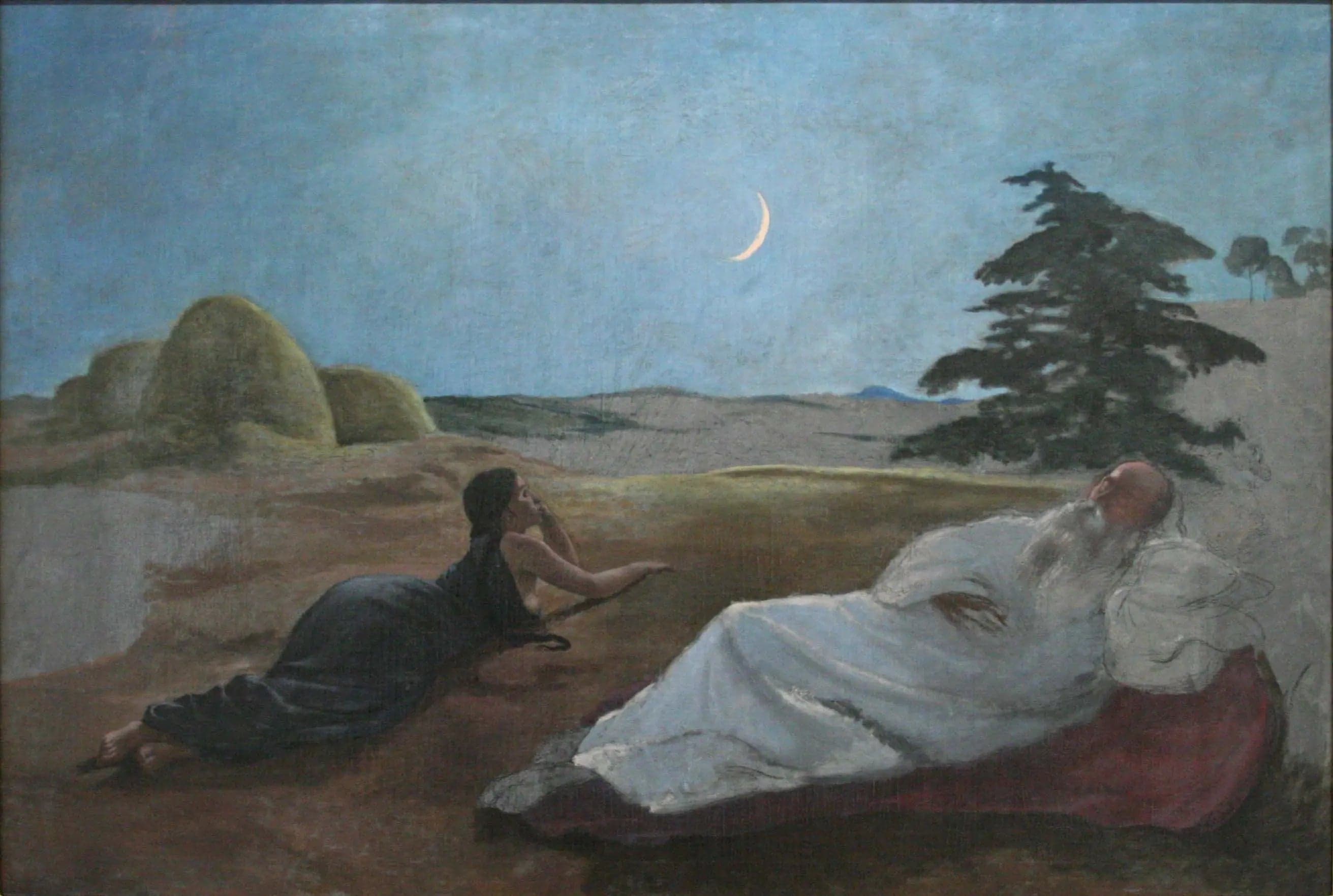
Ruth and Boaz
- Original dimensions
- 202.8 x 137.5 cm
- Museum
- Fabre Museum
- Year
- 1870
Scene depicted
The painting "Ruth and Booaz" illustrates a touching biblical scene, where Ruth, a widow and courageous, shows devotion to her father-in-law Booaz. The moment immortalizes human tenderness and difficult choices, while allowing each viewer to question their own values and relationships.
Historical context
Created in 1870, during a pivotal period of the Impressionist movement, the painting "Ruth and Booaz" is set in a rich geographical context. Made in Montpellier, this iconic work by Frédéric Bazille evokes a fusion of tradition and modernity. Currently, the canvas is preserved at the Fabre Museum , where visitors can admire the generous dimensions of this exceptional piece .
Place in the artist's career
This painting , emblematic of the beginning of the artist's career, heralds a stylistic peak. In parallel with his other canvas , "The Toilet," and "A Corner of the Garden at Montgeron," "Ruth and Booaz" testifies to Bazille's technical and emotional evolution, always engaged with themes of light and human interactions.
Anecdote
Frédéric Bazille once spoke about the creative process of this painting by saying: 'In every brushstroke, I capture a breath of life.' Reflecting on a sunny morning, his encounter with familiar faces in the streets of southern France infused this pictorial work with unparalleled emotional depth.