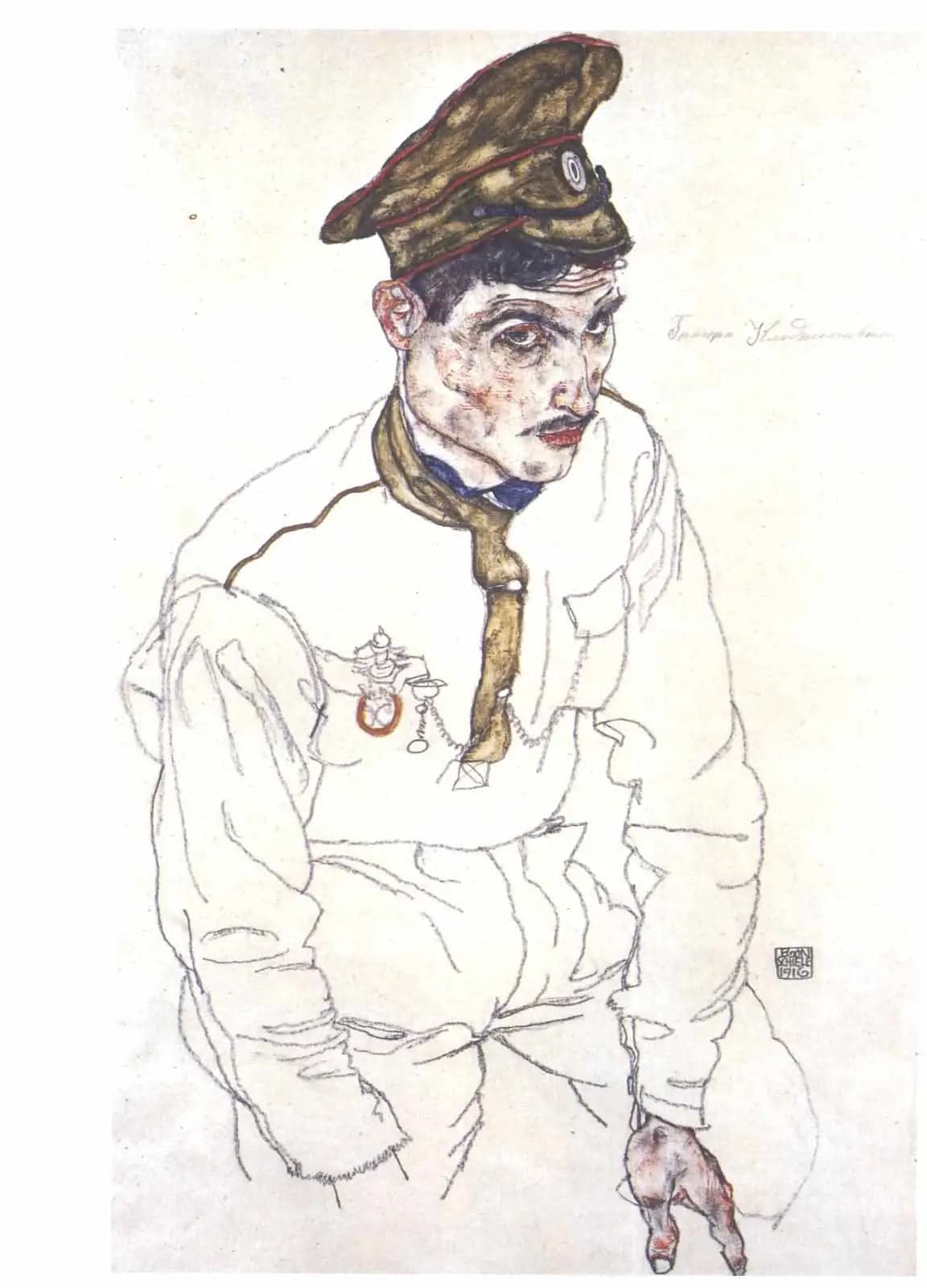
Russian Prisoner of War
- Original dimensions
- 30.8 x 43.8 cm
- Museum
- Art Institute of Chicago
- Year
- 1916
Scene depicted
The painting "Russian Prisoner of War" powerfully exposes the human condition, in the face of the absurdity of war. In this pictorial work, Egon Schiele depicts a detainee, whose gaze heavy with suffering captivates the viewer. Every detail of this painting reveals internal struggles, anguish, and despair, weaving a poignant and universal narrative that goes beyond the mere capture of an image.
Historical context
Created in 1916, the painting "Russian Prisoner of War" is set against the tumultuous backdrop of World War I. It was in Vienna, at the heart of the Austro-Hungarian Empire, that this canvas came to life, as the world was engulfed by the shadows of war. A member of an artistic movement that blends expressionism and psychological introspection, the work is today carefully preserved within the Art Institute of Chicago , carrying the pains and struggles of its time.
Place in the artist's career
"Russian Prisoner of War" stands as a major milestone in Schiele's career. It symbolizes his period of maturity, where his unique style reaches peaks of emotional expression. In parallel with his contemporary works such as "Self-Portrait" and "The Woman Applying Makeup," this canvas is part of a remarkable stylistic and thematic evolution.
Anecdote
"Every stroke I make on the canvas is a cry of the soul," Schiele said, inspired by the tragedy of the world around him. One peaceful spring morning, while walking through a quiet alley in Vienna, his gaze was captivated by the distress of a lost face, which will forever anchor powerful emotions at the heart of this masterpiece .