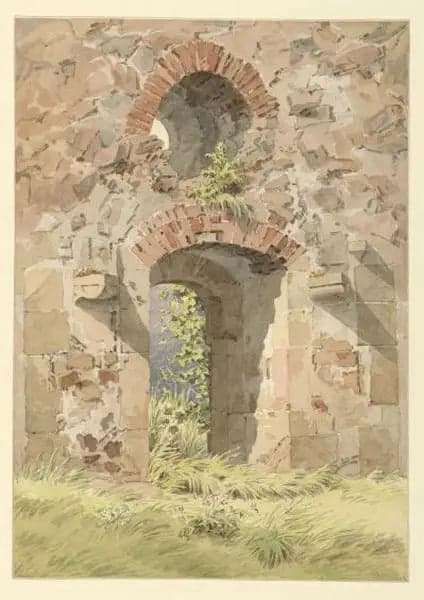
Ruins of the Heiligen Kreuz Gate, Meissen
- Original dimensions
- 14.9 x 21 cm
- Movement
- romanticism
- Museum
- Angers Museum of Fine Arts
- Year
- 1824
Scene depicted
The painting "Ruin of the Heiligen Kreuz Gate, Meissen" features a ruined Gothic gate, symbolizing the passage of time and the ephemeral beauty of human architecture. The composition reveals worn bricks covered in moss, testifying to nature reclaiming its rights. This marriage between stone and vegetation illustrates the duality of creation and decomposition, a theme dear to Friedrich that invites the viewer to reflect on the beauty of desolation.
Historical context
The painting "Ruin of the Heiligen Kreuz Gate, Meissen" was created in 1824 by Caspar David Friedrich , an iconic figure of the romantic movement. This painting, now housed in the Angers Museum of Fine Arts, is a visual exploration of the ruins of a historic gate in the city of Meissen, Germany. Through this pictorial work , Friedrich captures not only the architecture but also the soul of a place steeped in history, at a time when romanticism exalted nature and the nostalgia of the past.
Place in the artist's career
This painting represents a pivotal moment in Friedrich's career. His romantic style reaches impressive maturity here, foreshadowing other masterpieces such as " The Wanderer above the Sea of Fog " and " The Abbey in the Oakwood " where the solitude of figures facing nature is central to the emotion felt. This canvas perfectly illustrates his shift towards more introspective and spiritual themes.
Anecdote
"Every ruin is a promise of beauty and memory," Friedrich might have said while contemplating the scene that inspired him. On that gentle spring morning, he wandered through the streets of Meissen, absorbing the surrounding serenity, when his eyes fell upon the majestic ruin. This fleeting encounter with the landscape became the driving force of the canvas , imbued with deep feelings and delicate emotions.