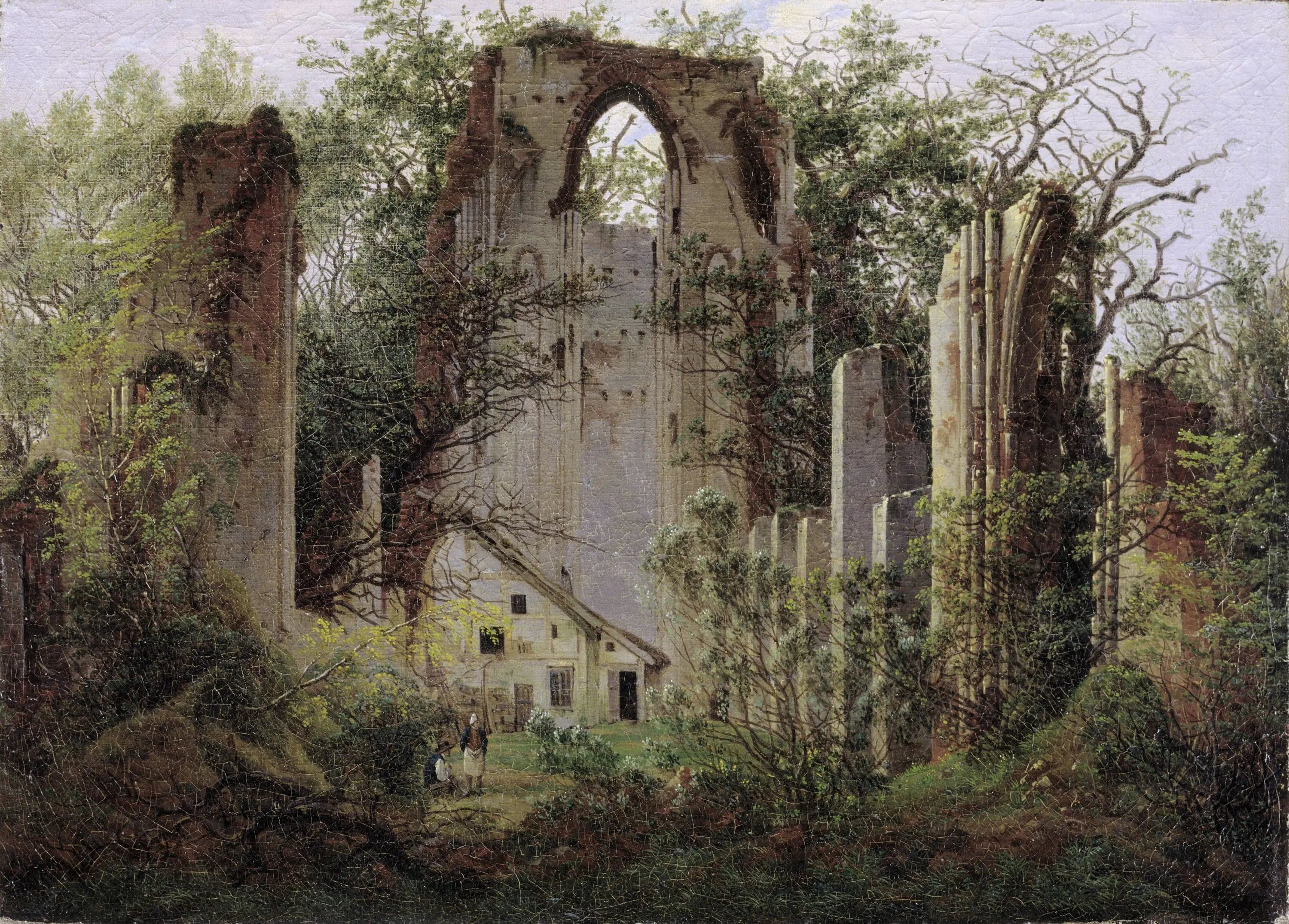
ruins of the Eldena Monastery, near Greifswald
- Original dimensions
- 49 x 35 cm
- Museum
- Alte Nationalgalerie
- Year
- 1825
Scene depicted
This painting represents the remnants of an ancient monastery, overtaken by nature, where the sky delicately merges with the ruins. Friedrich uses this scene to explore the relationship between man and the environment, challenging the time that erodes and transforms. The silhouettes of the pillars stand out in an atmosphere that seems suspended, drawing the gaze towards the infinity of the landscape in the background, while telling the story of a place imbued with mystery and poetry.
Historical context
Created in 1825, this iconic painting is set against the rich backdrop of Romanticism , a movement that explores the depth of human emotions in the face of nature. Nestled in Greifswald, a German city steeped in history, this work magnifies the ruins of a monastery, resonating with echoes of spirituality and memory that permeate this historic site. Today, this flagship painting is housed in the Alte Nationalgalerie , a museum in Berlin that holds treasures of European art.
Place in the artist's career
This painting is situated at a pivotal moment in Friedrich's career, marking a maturation of his artistic approach. It complements other significant works such as " The Wanderer above the Sea of Fog " and " The Sea of Ice ", illustrating his ongoing exploration of themes of nature, the sublime, and solitude. Each painting by Friedrich reveals the depth of his introspection and his unbreakable bond with nature.
Anecdote
As Friedrich said, "Nature is a permanent painting that invites us to contemplate our own interior." It was on a misty morning by the sea, facing these majestic ruins, that he found the inspiration to create this masterpiece . The fresh air mixed with the scents of pine and the sound of waves forms a perfect backdrop for this painting that evokes a sweet and poetic melancholy.