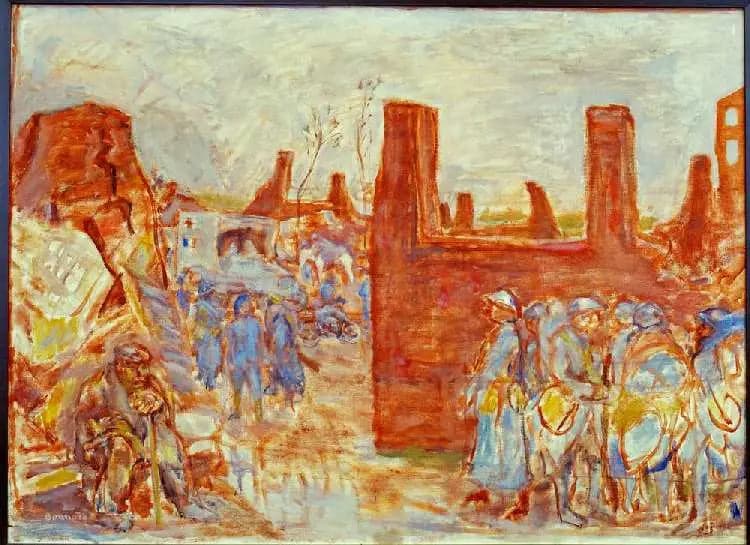
Ruined Village
- Original dimensions
- 86 x 63 cm
- Museum
- Atelier de l'histoire
- Year
- 1917
Scene depicted
The painting “Ruined Village” depicts an evocative landscape where nature reclaims its rights over abandoned buildings. The vibrant colors of the sky blend with the earthy tones of the crumbling walls, illustrating a striking contrast between the ephemeral beauty of a natural setting and the desolation of human remnants. It is a silent ode to past stories, to lives left behind, where each stroke tells a delicate nostalgia.
Historical context
Created in 1917, during the turmoil of World War I, this painting is an iconic work by Pierre Bonnard that belongs to the Nabi movement, a French artistic current that advocates personal expression beyond realism. The canvas is currently displayed at the Atelier de l'histoire, a place dedicated to art and memory, where it continues to fascinate and inspire. Its generous dimensions, 86 by 63 centimeters, amplify the emotion that this canvas conveys.
Place in the artist's career
This canvas marks a crucial step in the career of Pierre Bonnard , coming after “The Blue Nude” and before “The Terrace at Vernon.” This transition reflects the evolution of his style, moving from an exploration of human forms to a focus on nature and abandonment. His growing mastery of colors and emotional compositions becomes more evident, highlighting his unique talent.
Anecdote
“Art is the answer to the silent beauty that surrounds us.” In this forgotten corner of a village, Pierre Bonnard finds inspiration: a gentle spring breeze caresses the ruins, while the melodious song of birds dances with the leaves of the trees. It is in this atmosphere imbued with poetry that Ruined Village is born, a work that captures the very essence of nature and the melancholy of time passing.