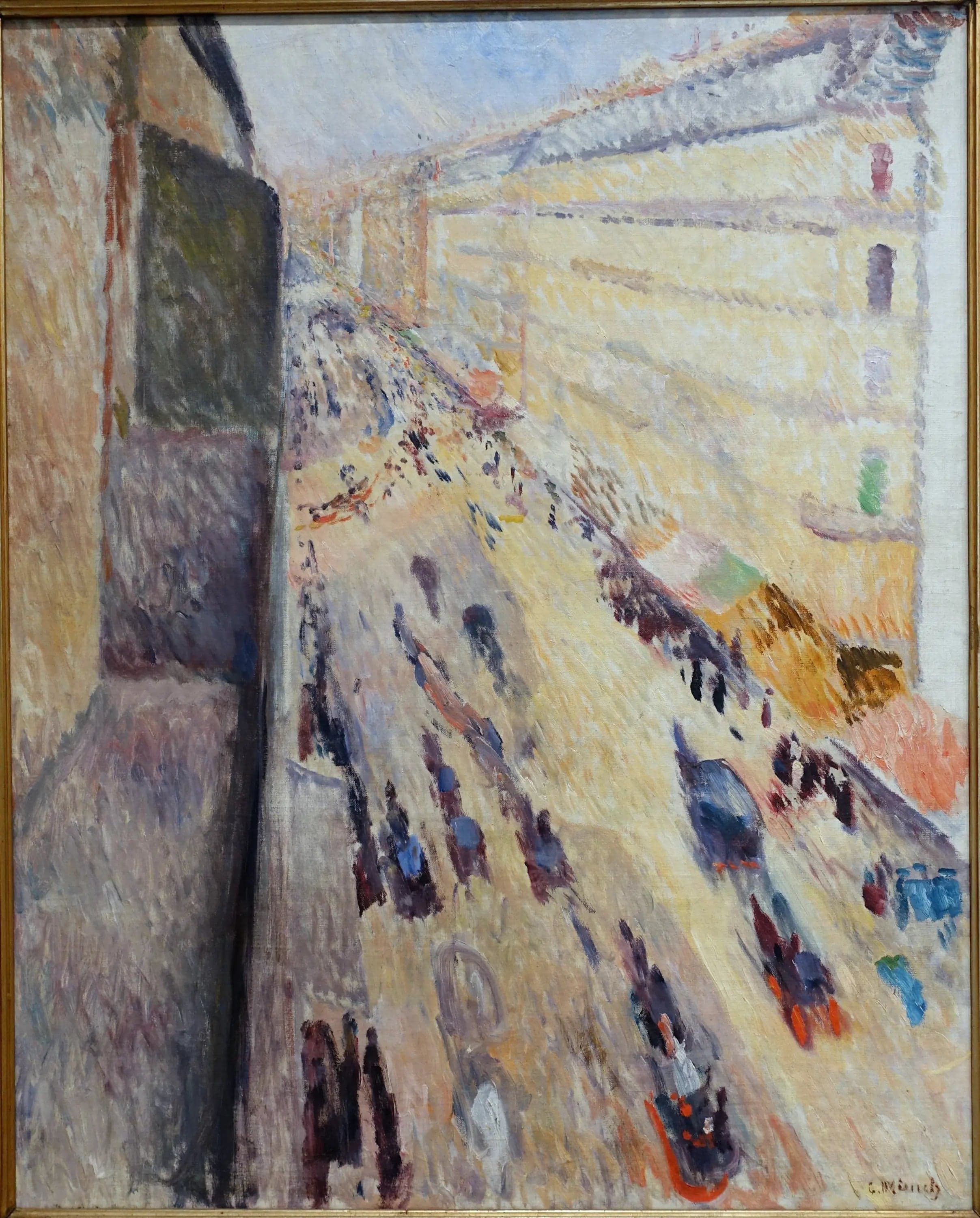
Rue de Rivoli
- Original dimensions
- 65.1 x 81 cm
- Museum
- Fogg Art Museum
- Year
- 1891
Scene depicted
The painting "rue de Rivoli" by Munch illustrates the passage of a misty Seine, where the silhouettes of characters subtly blend with the Haussmannian architecture of 19th century Paris. Each brushstroke, each layer of paint seems to defy time, capturing an atmosphere that is both nostalgic and vibrant, as if to immortalize a fleeting moment of daily life.
Historical context
Created in 1891, this painting is emblematic and immerses us in the Paris of a bygone era, vibrant with an impressionist intensity. Located in the heart of the city of light, the canvas is part of the symbolist movement, a movement that evokes deep emotions and reflection on existence. The painting is currently housed at the Fogg Art Museum , a bastion of art where it is carefully preserved.
Place in the artist's career
"rue de Rivoli" stands at the heart of Edvard Munch 's career, marking an important step towards his artistic maturity. Alongside his flagship works "The Scream" and "The Madonna," this painting reveals a significant evolution in his style, oscillating between realistic representation and unique emotional intensity.
Anecdote
Edvard Munch is often quoted saying: "Each painting is an emotion captured, a way to communicate without words." It is likely while strolling at dawn through the quiet streets of Paris, as the sun gently pierced the morning fog, that he drew inspiration for this masterpiece , highlighting the inherent melancholy of the human soul.