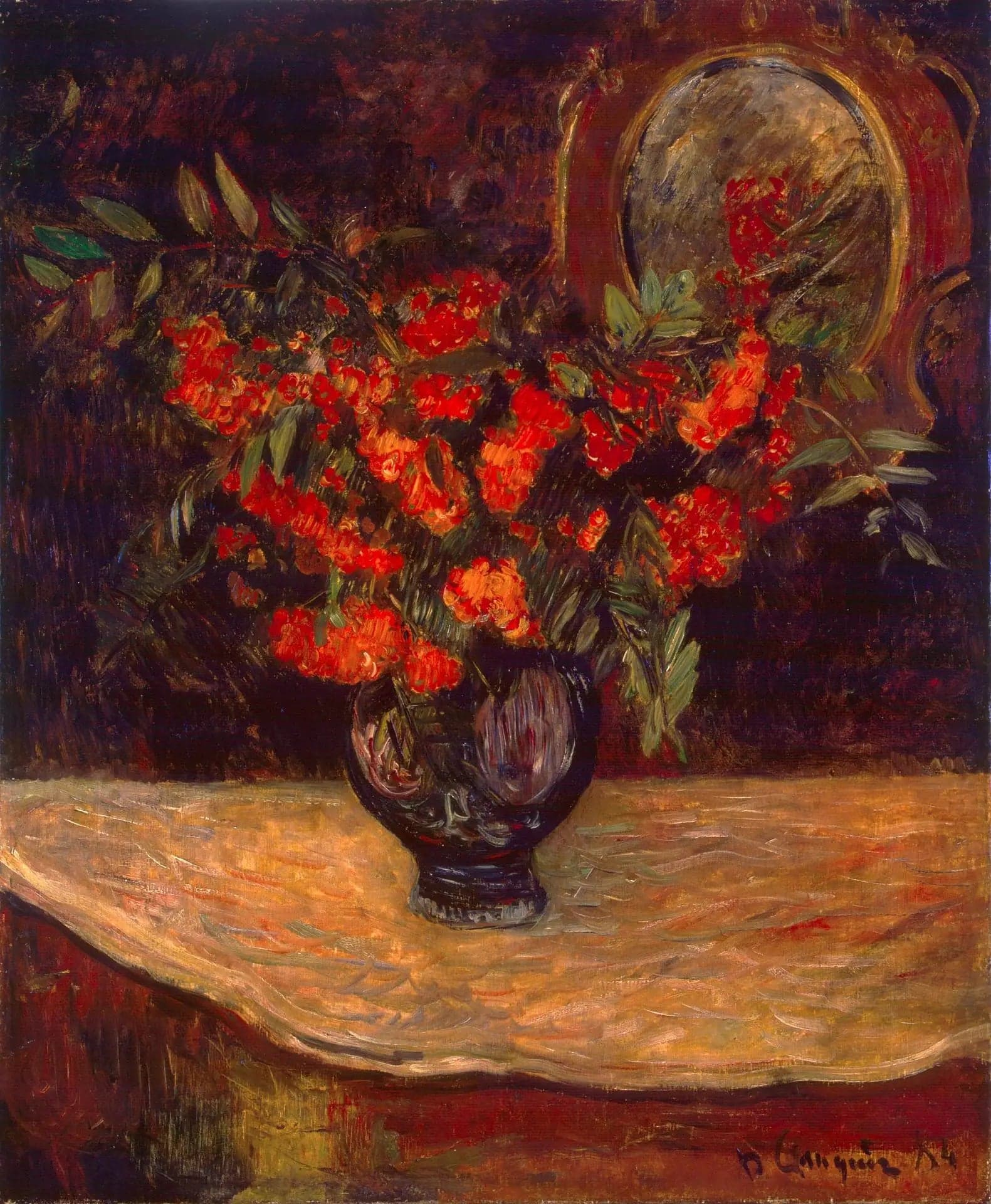
Rowan Bouquet
- Original dimensions
- 54.5 x 65.3 cm
- Museum
- Hermitage Museum
- Year
- 1884
Scene depicted
In this pictorial work , Gauguin presents us with a flamboyant bouquet of rowan, a burst of colors and life. The red raspberries and vibrant greens measure themselves around a vase that seems to vibrate with energy. Each element reveals itself as an essential component of a natural harmony, a testimony to the ephemeral beauty of spring-summer.
Historical context
Created in 1884, this painting is rooted in the post-impressionist movement, born in the heart of Paris. It is in this bubbling context of artistic experimentation that Paul Gauguin , in search of identity and authenticity, develops his unique style. The canvas is currently housed at the Hermitage Museum , a sanctuary for the most prized works.
Place in the artist's career
The Bouquet de sorbier is a fundamental milestone in Gauguin's career, revealing a style that will mature over time. While his previous canvases experimented with different techniques, here he establishes an unprecedented light, traversing the path of an artist in full evolution, alongside his other paintings such as “Vision after the Sermon” and “The Church of Pont-Aven.”
Anecdote
“Nature is a great muse, it whispers secrets in the heart of flowers.” On a bright spring morning, Gauguin captures the fleeting moment of a vibrant bouquet, an ephemeral encounter with beauty. This painting reflects the fascination the artist has for colors and light, making this canvas a true hymn to life.