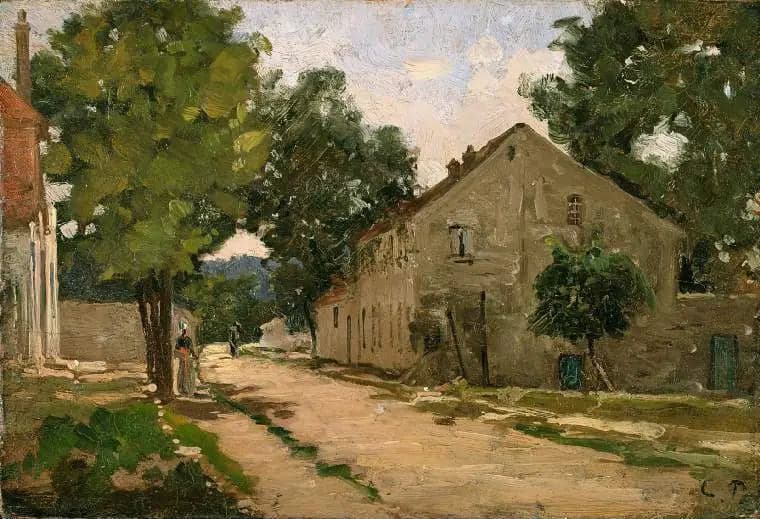
Route de Port-Marly
- Original dimensions
- 33.7 x 22.9 cm
- Museum
- Fitzwilliam Museum
- Year
- 1863
Scene depicted
This painting depicts a lively road at dawn, perfectly illustrating the transition between city and countryside. Pissarro brilliantly captures the animation of daily life, from silhouettes peacefully walking along the road to the vibrant foliage framing the scene. Light plays a crucial role in illuminating the canvas , creating a warm and welcoming atmosphere that invites the viewer to lose themselves in this moment of tranquility.
Historical context
Created in 1863, at a pivotal time in the Impressionist movement, the painting Route de Port-Marly by Camille Pissarro captures the excitement of a Paris in full transformation. This painting, currently exhibited at the Fitzwilliam Museum , perfectly illustrates the beginnings of Impressionism , an innovative artistic movement that sought to capture the light and colors of everyday life. The canvas, measuring 33.7 x 22.9 cm, immerses us in a vibrant landscape where nature and urbanity meet gracefully.
Place in the artist's career
Route de Port-Marly holds particular importance in Pissarro's career. Situated at a time when the artist was asserting his personal style, this painting marks a significant step towards a maturation of his artistic approach. In parallel, works such as Jardin d’Anna Pissarro and Boulevard Montmartre, Spring testify to the evolution of his vision, both technically and thematically.
Anecdote
Camille Pissarro once stated: “Nature is the greatest of mistresses.” This quote resonates particularly when considering the genesis of his masterpiece Route de Port-Marly , created on a sunny morning when he was inspired by the gentle whisper of the wind and the scent of spring flowers. It is in this idyllic setting that the painting comes to life, emitting through its brushstrokes a deep emotion and a contemplation of ephemeral beauty.