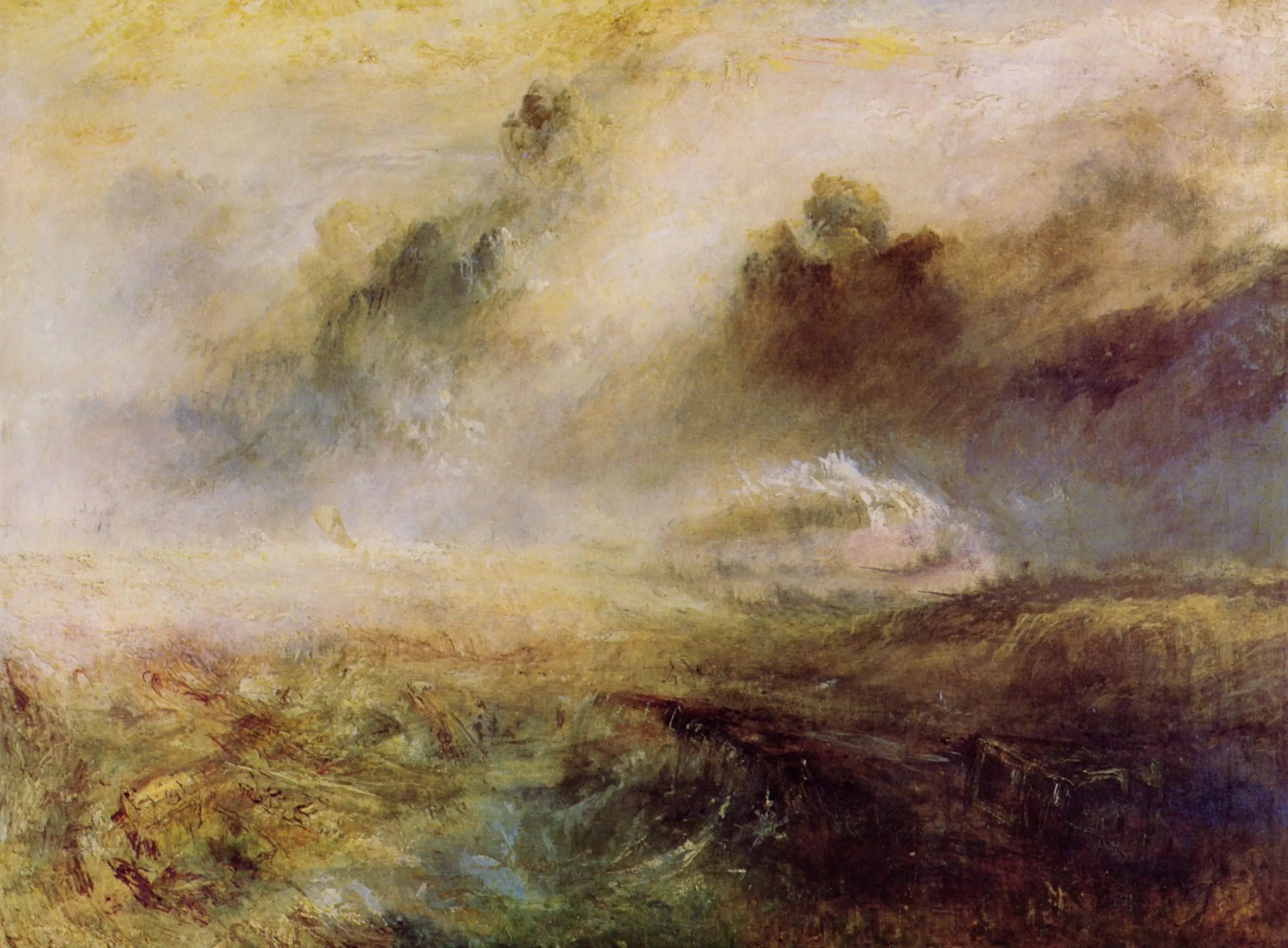
Rough Sea with Wreckage
- Original dimensions
- 92.1 x 122.6 cm
- Museum
- Tate
- Year
- 1840
Scene depicted
In Rough Sea with Wreckage , Turner depicts a chaotic maritime scene. The torn sails of a doomed ship blend with swirling waves, highlighting the desperate struggle of man against nature. The canvas is a tumultuous dance of colors and shapes, embodying the violence of the elements. The viewer is transported to the heart of a storm, almost feeling the salty water on their skin, illuminating the fragility of human existence.
Historical context
Created in 1840, the painting Rough Sea with Wreckage is part of the romantic movement, beautifully illustrating the artist's sensitivity to the forces of nature. This iconic painting, now housed at the Tate in London, represents a period of great artistic excitement where emotion and personal expression took precedence over realism . Turner, a witness to the industrialization of his time, immerses us in a tumultuous maritime atmosphere, revealing a deep echo of the human soul.
Place in the artist's career
Rough Sea with Wreckage represents a turning point in Turner’s career, where he begins to exploit the effects of light and movement in an unprecedented way. When compared to The Fighting Temeraire and Rain, Steam and Speed , one notices the evolution of his technique, his ability to translate emotion through chaos, and the growing importance of light in his compositions.
Anecdote
“The sea is a living painting, never the same, always changing,” said Turner. It was during a storm in Margate, that spring morning, that the artist found the fleeting inspiration for his masterpiece . The cries of seagulls pierced the salty air, while the roaring waves crashed against the rocks, urging him to capture the power and beauty of this unleashed ocean through his painting .