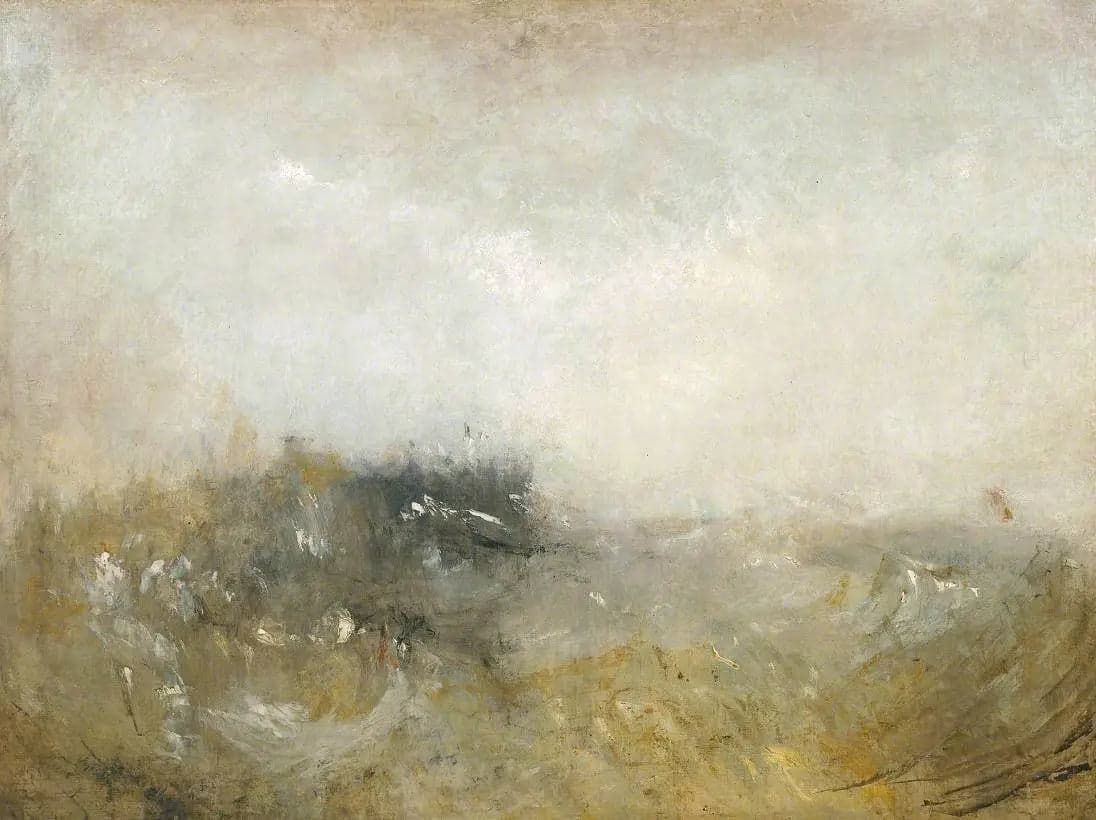
Rough Sea
- Original dimensions
- 91.4 x 121.9 cm
- Museum
- Tate
- Year
- 1842
Scene depicted
The painting depicts a raging sea, where the waves rise like giants, interspersed with stormy shades of gray and bursts of light. The boats, fragile silhouettes, seem to struggle in this wild expanse. The work recalls the fierce struggle between man and the relentless forces of nature, expressing the terror and fragile beauty of the scene.
Historical context
Created in 1842, the painting Rough Sea is at the heart of British romanticism , a movement that favored emotion and the sublime beauty of nature. It was in London, a vibrant city, that Turner conceived this masterful work. His canvas is now located in the famous Tate museum, where it still evokes the power of the tumultuous seas that the artist so passionately captured on his canvas.
Place in the artist's career
In Turner’s career, Rough Sea marks a period where the artist brilliantly masters storms and clearings. Like his other canvases , such as The Last Voyage of the Téméraire and Rain, Steam and Speed , this canvas reflects an evolution towards an emerging impressionist abstraction while retaining the romantic elements that define his style.
Anecdote
“The sea is a poem that sings to the wind.” These words resonate like a sweet melody, illustrating the moment of inspiration for Turner’s masterpiece . One evening, while contemplating the roaring waves from the shores, the artist felt a convulsion of the sea that led him to paint the furies of the ocean. This brings to life Rough Sea , a centerpiece charged with raw emotion.