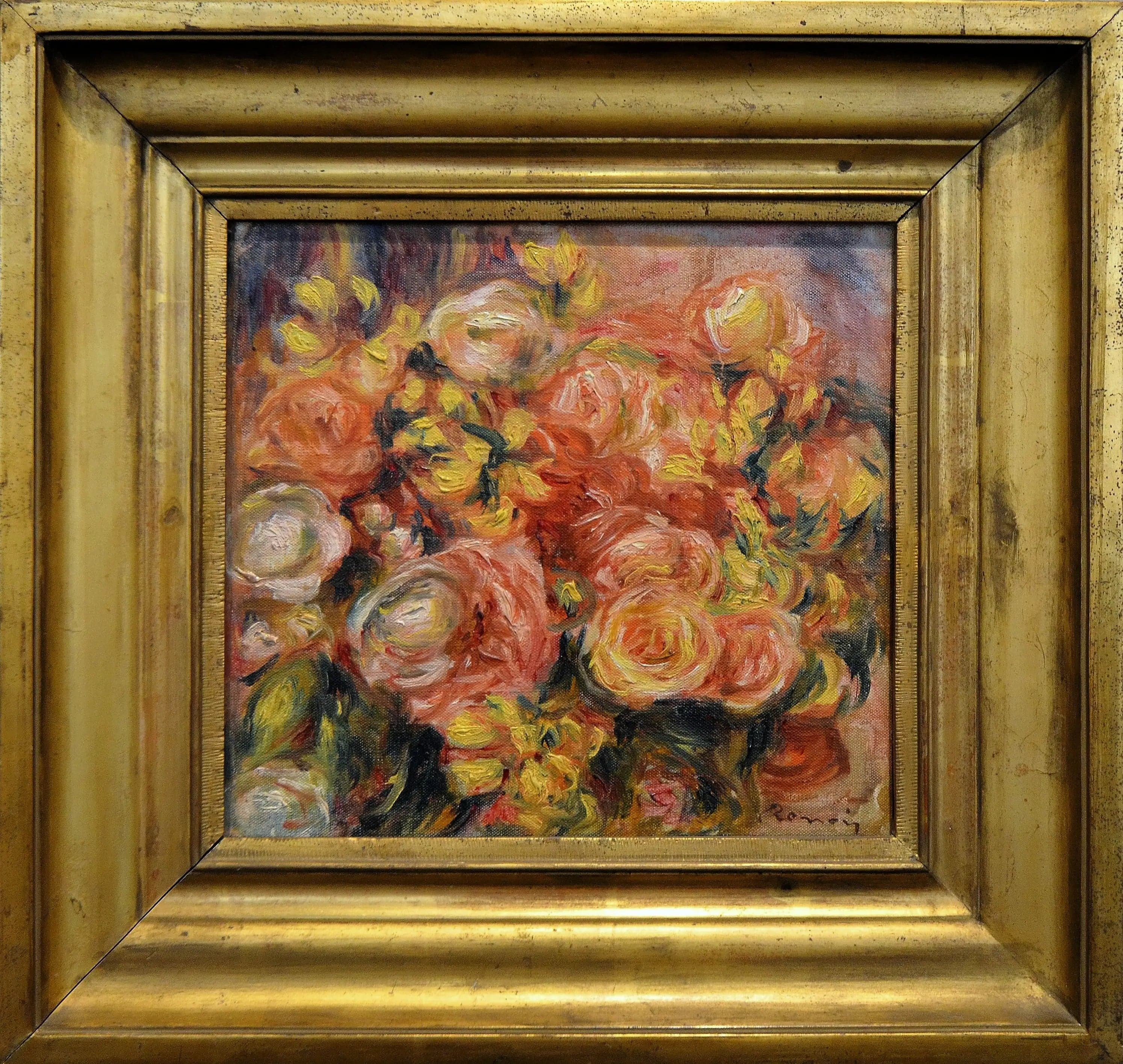
Roses - Pierre
- Original dimensions
- 30 x 27 cm
- Museum
- Museum of Fine Arts and Archaeology of Besançon
- Year
- 1915
Scene depicted
The composition of "Roses" reveals a subtle play between shadows and lights, where each petal seems to vibrate with life. The roses, symbols of ephemeral beauty, are delicately arranged, creating a harmonious dance of colors that evokes both sweetness and passion. This canvas is not just a floral representation; it is a visual poem that awakens the senses and invites contemplation.
Historical context
Created in 1915 in the historic city of Besançon, this painting is part of the Impressionist movement. At that time, Renoir explored the nuances of light and color, transcending simple representation to touch on emotion. This canvas is today preserved at the Museum of Fine Arts and Archaeology of Besançon, a true ode to floral beauty that captivates visitors with every glance.
Place in the artist's career
This canvas represents a significant step in Renoir's career, an artist already recognized for his masterful works such as "Luncheon of the Boating Party" and "Dance in the City." "Roses" is set in a period where his style reaches maturity, marrying impeccable technique and raw emotion, paving the way for many future pictorial explorations.
Anecdote
Renoir once declared: "Flowers are the smiles of nature." We can imagine this moment of inspiration, where the morning sun illuminates his studio, the rose petals dance under a soft light, filling the air with their delicate fragrance. The emotion of this painting thus comes to life, capturing both the lightness and depth of nature.