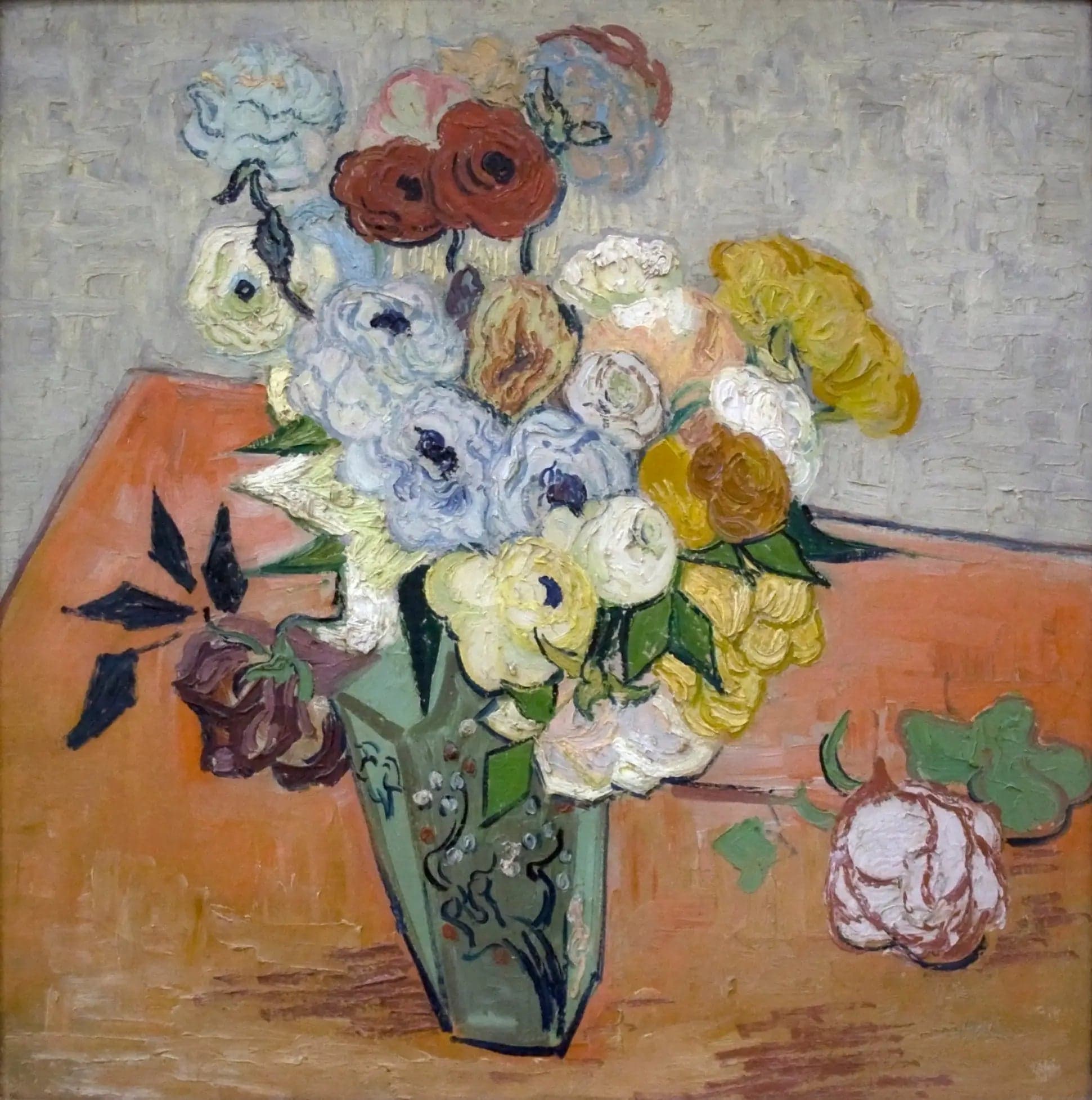
Roses and Anemones
Scene depicted
The painting Roses and Anemones immerses us in a lush floral universe. In this harmonious composition, delicate roses and vibrant anemones intertwine, creating a dialogue of exceptional colors. Each flower seems to vibrate under Van Gogh's brush, evoking emotions ranging from tenderness to melancholy, a contemplation of the ephemeral beauty of life.
Historical context
Created in 1890, during the tragic year marking the end of the artist's life, the painting Roses and Anemones was born in Auvers-sur-Oise , a charming village located north of Paris . This iconic painting is part of the post-impressionist movement, where emotion takes precedence over realistic representation. Today, this work is housed in the Orsay Museum , thus representing the spirit of the Belle Époque. Its dimensions, 52 x 51.7 cm, make it a delicate piece that draws the eye.
Place in the artist's career
Situated at a crossroads in Van Gogh's career, Roses and Anemones reflects his artistic maturity. This painting belongs to a period when the artist, at the height of his expressiveness, reveals both his inner turmoil and his love for nature. When viewed in perspective with The Starry Night and The Sunflowers , one perceives a stylistic evolution marked by bold colors and emotional depth.
Anecdote
“I want to paint flowers as a means of accessing the soul.” This quote from the Dutch painter resonates with particular intensity when observing Roses and Anemones . Inspired by the beauty of the gardens in Auvers, Van Gogh captured a spring morning, where the scent of flowers filled the air, and each petal became a colored note in his pictorial symphony.