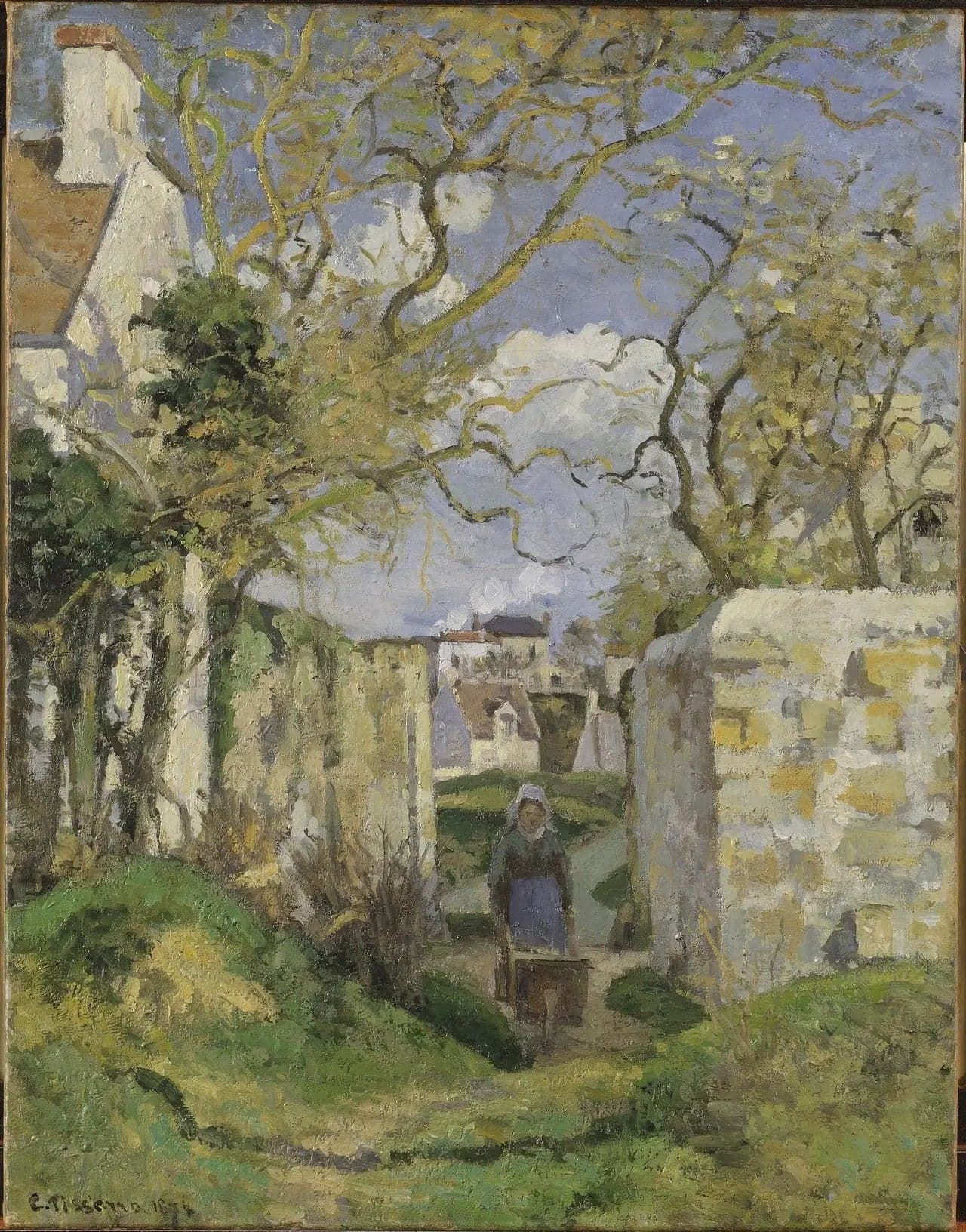
Rondest House, Pontoise
- Original dimensions
- 51 x 65 cm
- Museum
- Nationalmuseum
- Year
- 1874
Scene depicted
In the canvas “house Rondest, Pontoise,” the scene depicts a modest house, a gem of everyday life, where light dances subtly on the stone walls. Shadows stretch, colors vibrate, evoking both calm and movement. One perceives the perfect fusion between simple architecture and the surrounding nature, thus creating a soft and welcoming atmosphere.
Historical context
Created in 1874, this painting is emblematic of Pontoise, a town that becomes the catalyst for many canvases impressionist s. This work belongs to the artistic movement of realism , emerging at the heart of a time when artists strive to capture everyday life with unprecedented honesty. Currently, the painting is occasionally exhibited at the Nationalmuseum , where its beauty and impact continue to captivate art lovers.
Place in the artist's career
The painting “house Rondest, Pontoise” marks a pivotal period in Pissarro's career. Positioned after his impressionist experiments impressionist s, this work asserts itself as a testament to his technical mastery. In parallel, his works like “La Place du Théâtre Francais” and “Les Jardins de l'Ermitage” reveal an evolution towards an even bolder and more personal composition, consolidating his status in the history of art.
Anecdote
“Nature speaks to me at every moment; it is enough to know how to listen.” one might imagine Camille Pissarro expressing during the creation of this masterpiece . Settled on the banks of the beautiful Oise, Pissarro would have been inspired by a gentle morning light filtering through the leaves, a suspended moment where the air is filled with the floral scents of spring. This dialogue between the artist and his environment finds a powerful echo in the emotion conveyed by the painting .
Major exhibitions
Q109467244