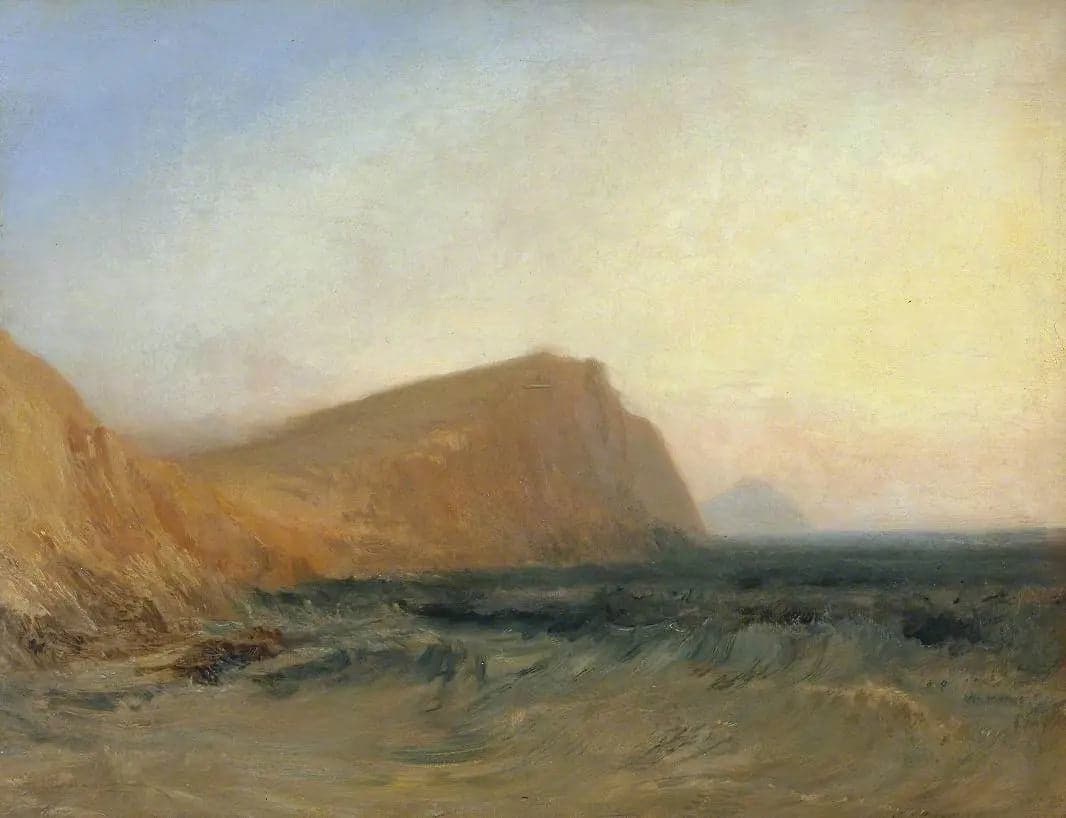
Rocky Coast
- Original dimensions
- 50.2 x 65.7 cm
- Museum
- Tate
- Year
- 1827
Scene depicted
In Rocky Coast , Turner captures the harshness and beauty of nature. He depicts a rocky coast where the waves crash forcefully against the cliffs, while a troubled sky stretches across the horizon. This canvas is a tribute to the majesty and violence of the ocean, reminding us of the power of nature in the face of human fragility.
Historical context
Created in 1827, in the vibrant city of London, Rocky Coast is part of the romantic movement, a time when art explored the deeply rooted emotions of humanity in the face of nature. This iconic painting is currently housed in the Tate museum, where it continues to evoke memories of coastal England to the viewer. Its generous format, with dimensions of 50.2 x 65.7 cm, offers an immersion into its tumultuous landscapes.
Place in the artist's career
Rocky Coast stands at the heart of Turner’s career, reflecting his growing mastery of light and atmospheres. Initially, in The Fighting Temeraire , he plays with the nostalgia of the sea, then in The Slave Ship , he addresses social themes with intensity. This painting reveals the maturity of his style and his exploration of emotions in the face of the sea.
Anecdote
Joseph Mallord William Turner often stated: "Light is life!" This principle was dear to him. Imagine him, one foggy morning at the edge of the sea, observing the shimmering waves, illuminated by the soft filament of a rising sun. This inspiration, imbued with emotions, gave birth to this emotive pictorial work .