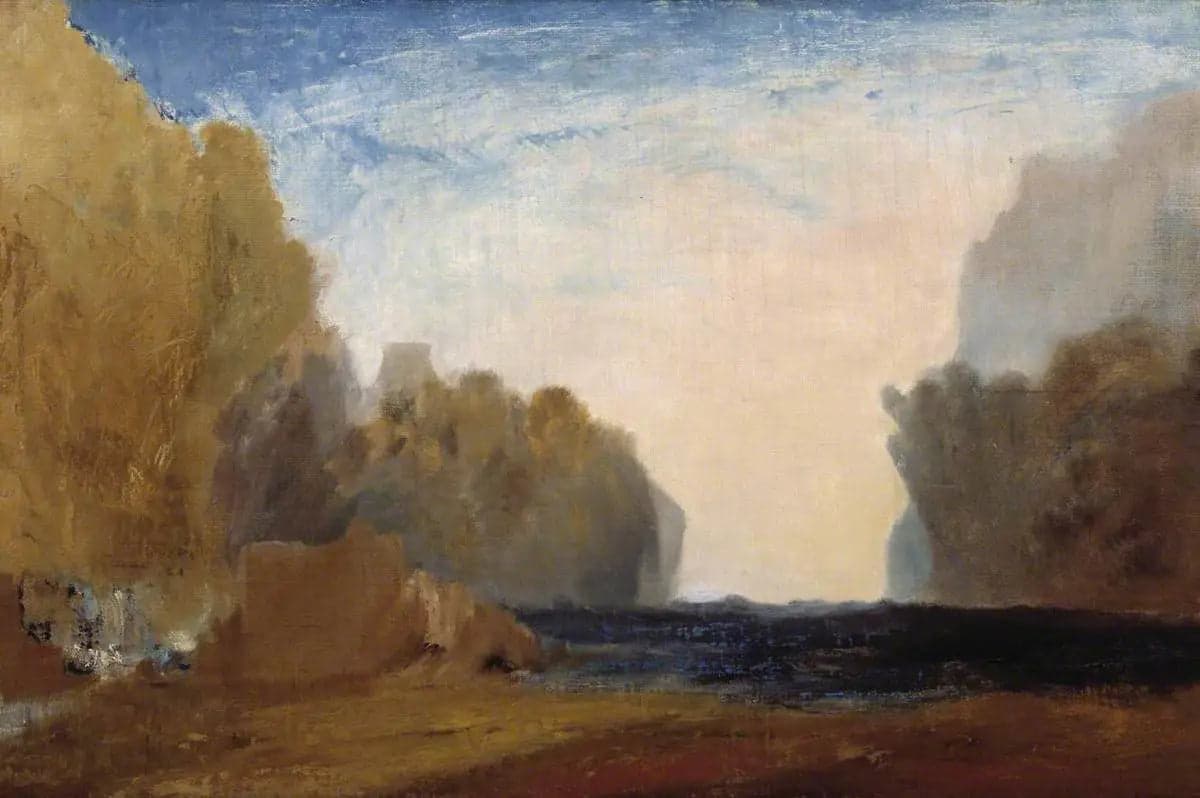
Rocky Bay
- Original dimensions
- 60.3 x 92.1 cm
- Museum
- Tate
- Year
- 1827
Scene depicted
"Rocky Bay" captures the wild splendor of the British coast, where the tumult of the sea unites with the tranquility of the darkened sky. This canvas evokes marine elements, blending mist and clarity to create an almost mystical atmosphere. The white sails of the boats and the rocks emerging from the waves are rendered with such vigor that one can almost hear the whisper of the waves.
Historical context
Created in 1827, this painting is housed in the prestigious Tate in London. "Rocky Bay" is the result of the romantic movement, a period where emotional expression took precedence over academic rules. The painting thus becomes a gateway to the majesty of British landscapes, evoking both the natural beauty and the melancholy of lost sailors.
Place in the artist's career
This painting represents a crucial step in Turner's evolution. It is part of his maturity period, also marked by "The Fighting Temeraire" and "Rain, Steam and Speed." In these paintings , Turner experimented with light and color, demonstrating a deep understanding of human emotions through nature.
Anecdote
Turner often stated that his art is inspired by nature, as evidenced by this quote: "Light is the key to every pictorial work ." He conceived "Rocky Bay" during a walk by the sea, where the thrill of the waves and the golden shimmer of the sun's rays were inspirations that energized his brush. This painting is a vibrant reflection of his love for coastal landscapes.