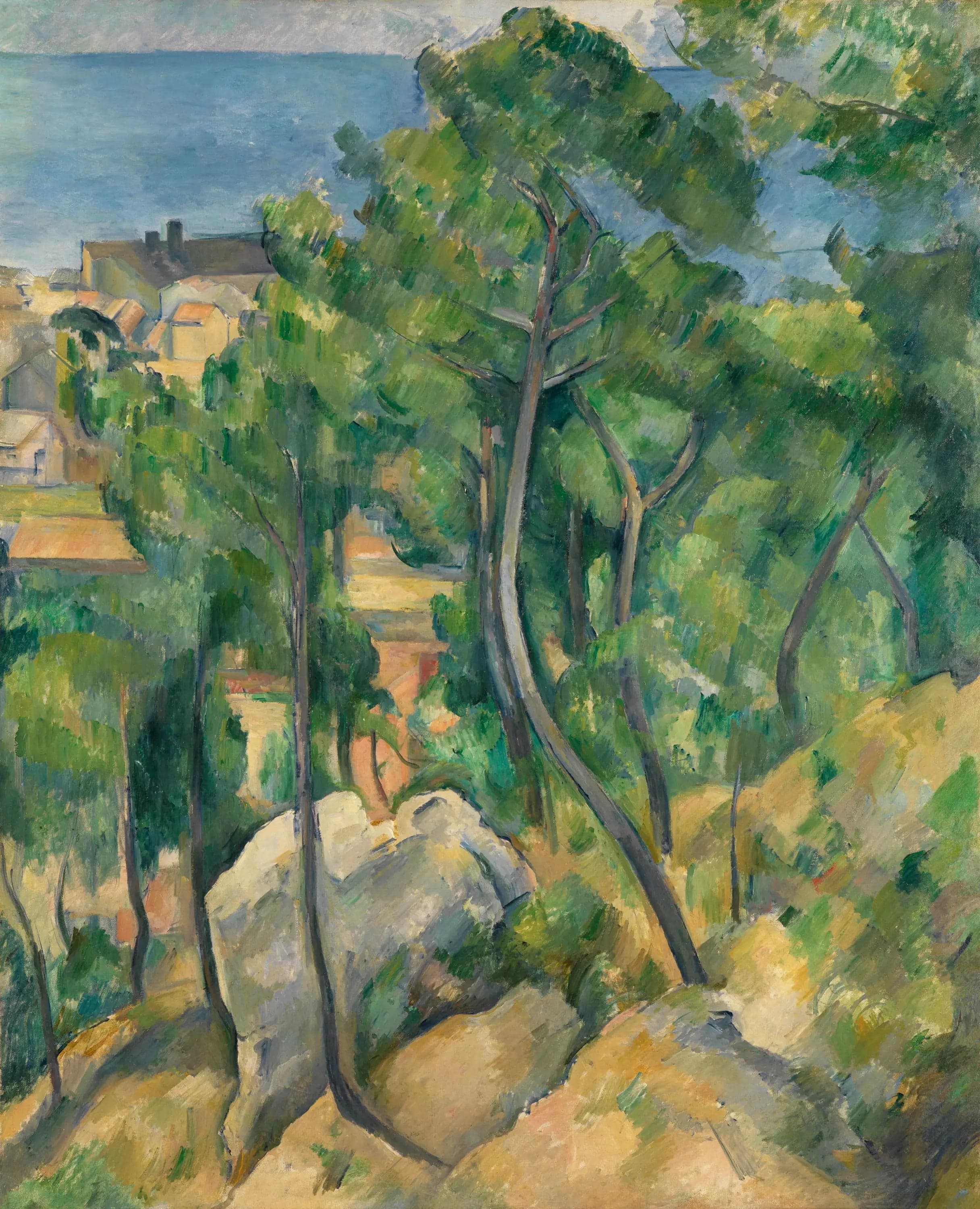
Rocks, Pines, and Sea at L'Estaque
- Original dimensions
- 81 x 100 cm
- Museum
- Staatliche Kunsthalle Karlsruhe
- Year
- 1884
Scene depicted
The painting “Rochers, pins et mer à l'Estaque” depicts a fascinating scene where nature expresses itself in all its splendor. The rocks, with sculptural shapes, stand proudly against the blue immensity of the sea, while the pines, slender silhouettes, seem to dance in the Mediterranean breeze. Light plays a predominant role, bringing a unique vibration that animates this pictorial work and invites the viewer to escape to distant shores.
Historical context
Created in 1884, this painting emblematic finds its inspiration in the charming commune of l'Estaque, located on the sunny coasts of the Mediterranean, in France. Paul Cézanne , master of post-impressionism , offers with this canvas a bold and vibrant vision of nature, where steep rocks, majestic pines, and the immense azure sea intertwine. This canvas is currently exhibited at the Staatliche Kunsthalle Karlsruhe , a favored stop for art lovers wishing to discover the treasures of the 19th century.
Place in the artist's career
This canvas , essential in Cézanne's career, marks a period of artistic maturation. It is part of his quest for a pure form and a harmonious composition. Alongside canvases such as “La Montagne Sainte-Victoire” and “Les Joueurs de cartes,” “Rochers, pins et mer à l'Estaque” testifies to a technical evolution towards a controlled abstraction where nature and emotion converge.
Anecdote
“Nature does not repeat itself, it renews itself.” This reflection of Cézanne resonates deeply when observing the painting “Rochers, pins et mer à l'Estaque.” Let’s imagine the painter, walking one bright morning along the shores, soaking in the maritime scents and vibrant colors that surround him. This radiant atmosphere undoubtedly nourished the evocative power of his masterpiece .