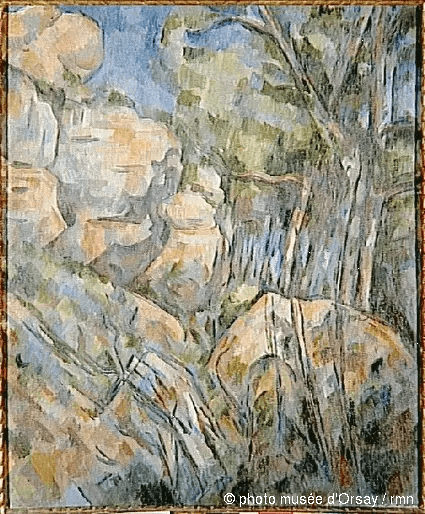
Rocks near the caves above Château Noir
- Original dimensions
- 54.5 x 65.5 cm
- Museum
- Orsay Museum
- Year
- 1904
Scene depicted
In this pictorial work, Cézanne reveals a mountainous scene where shadows and lights intertwine, highlighting the majesty of the rocks that dominate the landscape. The canvas transports the viewer into a universe where nature is vividly drawn, each detail being an invitation to contemplation. The geometric and volcanic shapes of these rocks testify to the artist's unique style, while paying homage to the timeless beauty of the region.
Historical context
Created in 1904, this painting embodies the genius of Paul Cézanne , a pioneer of the Post-Impressionist movement. Located in Paris, this work is the quintessence of the interaction between art and nature, capturing the magic of the Provençal landscapes that so inspired the artist. The canvas , now displayed at the Orsay Museum , stands as a monument of creativity, merging forms, colors, and emotions into a composition of great depth.
Place in the artist's career
This painting , situated at a pivotal moment in Cézanne's career, marks a decisive turning point. It fits perfectly into a series of creations, echoing works such as “The Montagne Sainte-Victoire” and “The Large Bathers,” illustrating his journey towards abstraction. Rocks near the Caves above Château-Noir thus asserts itself as one of the pillars of his mature style, where nature becomes a symphony of forms and colors.
Anecdote
“Nature can only be our sole and true source of inspiration.” These words from Cézanne evoke that sunny morning when, facing the rocks at the edge of Château-Noir, he captured the light in his creative flow. Each brushstroke of this painting is imbued with this essence, transporting us to the heart of that precious moment.