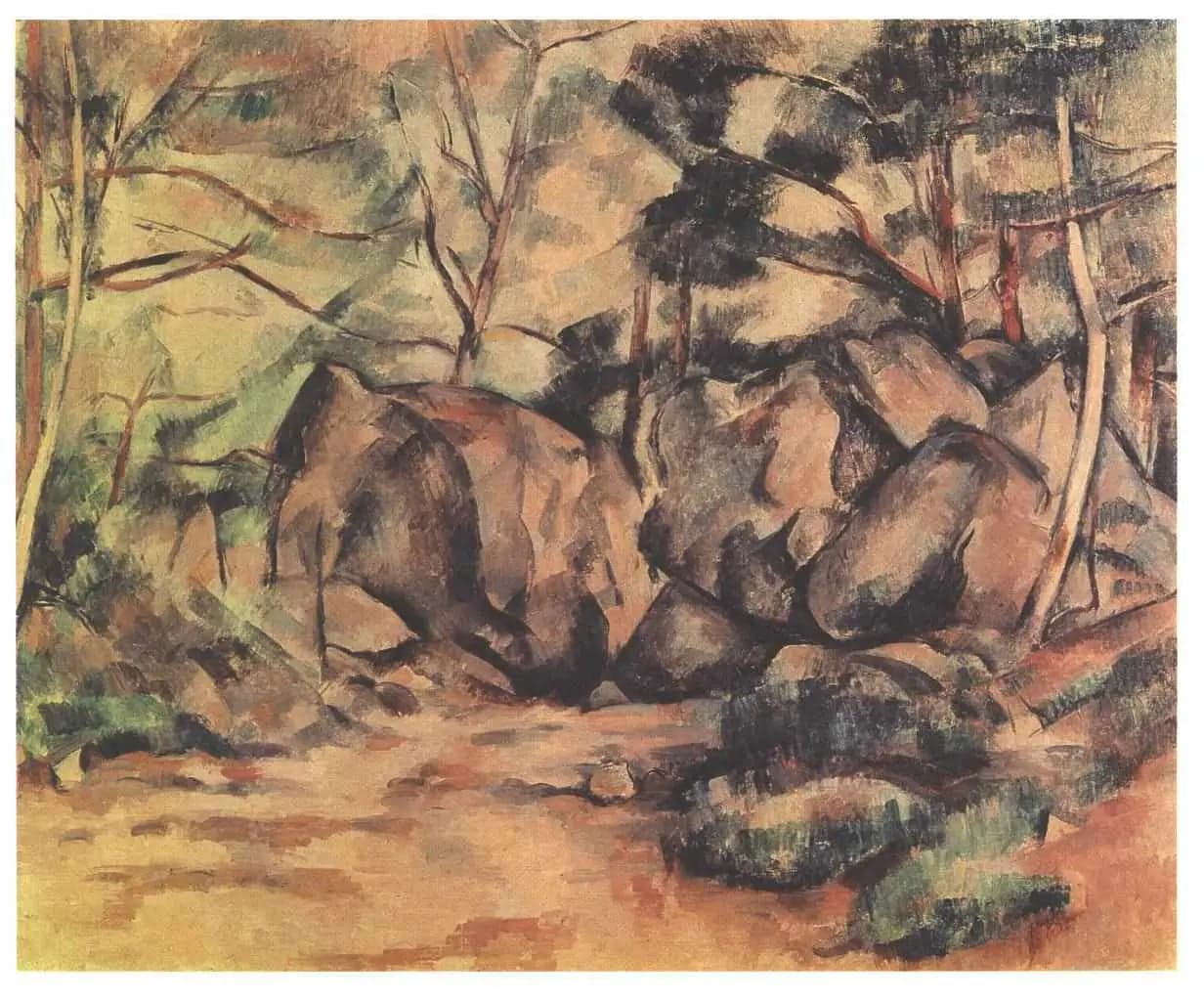
Rocks in the Woods
- Original dimensions
- 61 x 51 cm
- Museum
- Kunsthaus Zurich
- Year
- 1893
Scene depicted
In "Rocks in the Woods," Cézanne immerses us in a wild universe, where the robustness of the rocks blends with the softness of the greenery. The painting transports us along a path, between shadow and light, inviting us to feel the tranquility and vastness of this wooded scene. Geometric shapes emerge, highlighting a nature that is both raw and harmonious, vibrant with energy.
Historical context
Created in 1893, the painting "Rocks in the Woods" is emblematic of the post-impressionist movement. Paul Cézanne , a pillar of modern art, settled in Aix-en-Provence, France, and was able to capture the essence of the surrounding landscapes. Currently, this canvas is displayed at the Kunsthaus Zurich , a sanctuary of art where one can admire its beauty. The dimensions of this canvas , 61 x 51 cm, testify to the delicacy of the scene it represents.
Place in the artist's career
This painting is situated at a turning point in Cézanne's career, marking a period of profound innovation. Compared to other paintings such as "The Montagne Sainte-Victoire" and "The Artist's Garden," it reveals the evolution of his style towards bolder and simplified compositions, where emotions are at the heart of each brushstroke.
Anecdote
"Nature is everything, it is she who inspires me," Cézanne might have declared on that magnificent spring morning. It is amidst the green peaks, cradled by the gentle whisper of the wind, that he found inspiration to capture the volumes and light emanating from the rocks. Thus, this pictorial work becomes a reflection of his intimate dialogue with nature.